Phillip Francis
"Scooter" Rizutto
(With Friend)
(Click on the image to zoom in.)
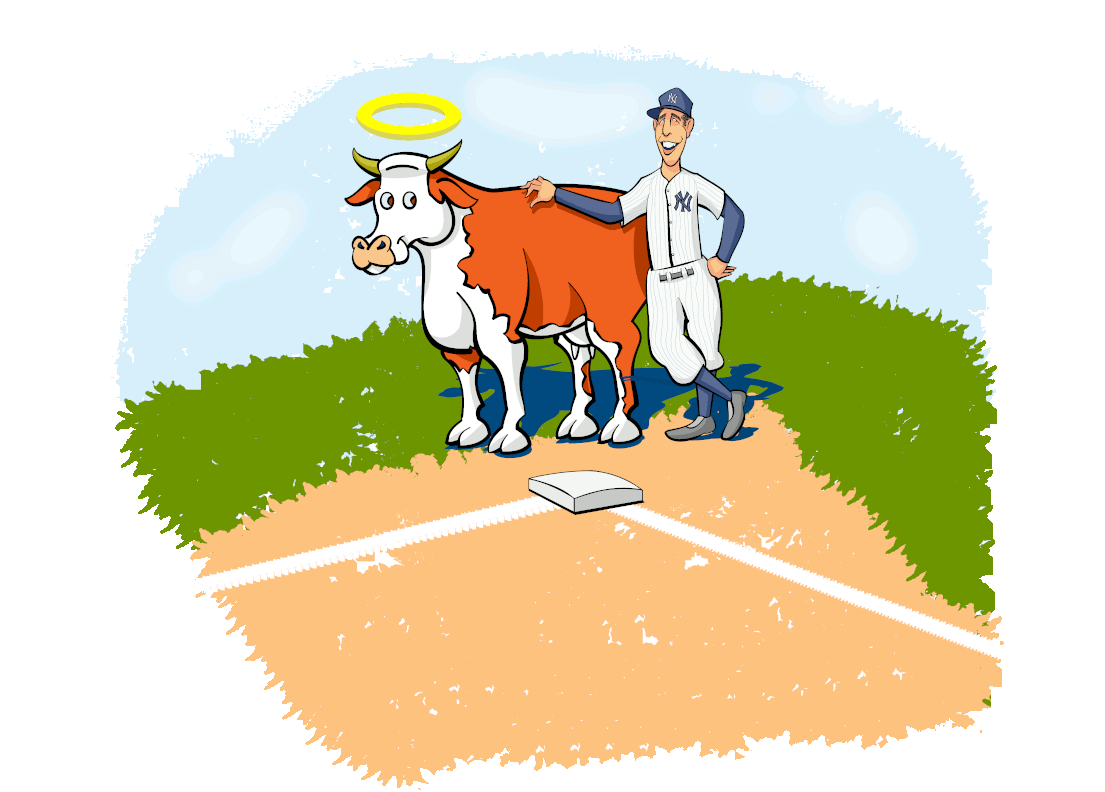
Of course if you consider the likes of Joe Dimaggio, Ty Cobb, and of course, the Great George Herman "Babe Ruth", your average man and woman on the street may not be aware of the major league baseball player Philip Francis Rizzuto.

Joe

Ty
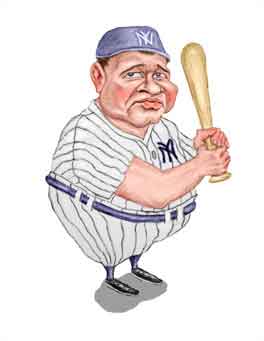
Babe
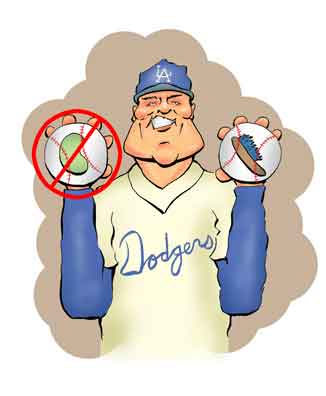
Don Drysdale
Broadcasters Middle Western
Those of a bit less venerable heritage, though, may remember Phil for his 40 years of broadcasting for the New York Yankees. "Scooter" - his nickname from his playing days - was known not only for his knowledge of the game and his ability to explain the action on the field but also for his distinctive manner of speaking.
Many players like Don Drysdale who in their playing days spoke "in dialect" (a polite way to say "with a twang") and then went into broadcasting learned to speak in what may be called Broadcasters Middle Western. That is a neutral sounding "typical" American accent or as elocution teachers say the General American Accent.
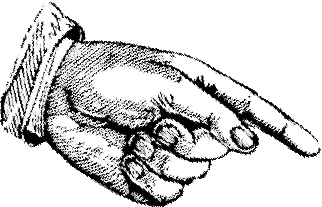
But Scooter kind of went the other way. During his years with the Yankees, his speech was well-modulated with little of the Brooklynese of his youth. But when he began broadcasting his style became "folksy" if we might put it mildly. His play calling also had a hint of stream of consciousness which produced a unique and even whacky narrative. His favorite expression after a great play or a big hit might be guessed from the picture.
But first of all Phil was a player. He played shortstop for the Yankees beginning in 1941 and following three years in the Navy from 1943 to 1945, returned to the team before retiring in 1956.
Phil, though, had a bit of trouble even getting into baseball. He was a star on his high school team but when he tried out for the Dodgers in 1935 Phil was only sixteen. Then as he stood over the plate to show the coaches how he could hit, he got smacked in the back by a - quote "wild pitch" - unquote.1
Footnote
That Phil got hit in the back suggests the pitch might have been a deliberate "bean ball". A characteristic of a bean ball - that is, a ball deliberately tossed to hit the batter - and kids, don't try this at home (or anywhere else) - is that it is aimed behind the batter. That's because immediately after the throw, the batter only has time to see that the ball - moving at 90 miles an hour - is heading his way. His instinct, then, is to jerk back, and he will move into the path of the ball.
Tossing a bean ball is, of course, against the rules which specifically state:
Rule 8.02: Throwing at the Batter
The pitcher shall not intentionally pitch at the batter.
If, in the umpire's judgment, such a violation occurs, the umpire may elect either to:
- Expel the pitcher, or the manager and the pitcher, from the game, or
- May warn the pitcher and the manager of both teams that another such pitch will result in the immediate expulsion of that pitcher (or a replacement) and the manager.
After that he could barely swing the bat. The coach - it wasn't Casey Stengel or Leo "The Lip" Durocher - told him to go home. Then Phil showed up for the Giants tryout. One of the assistant coaches took one look at the kid and told him to get a shoeshine box.
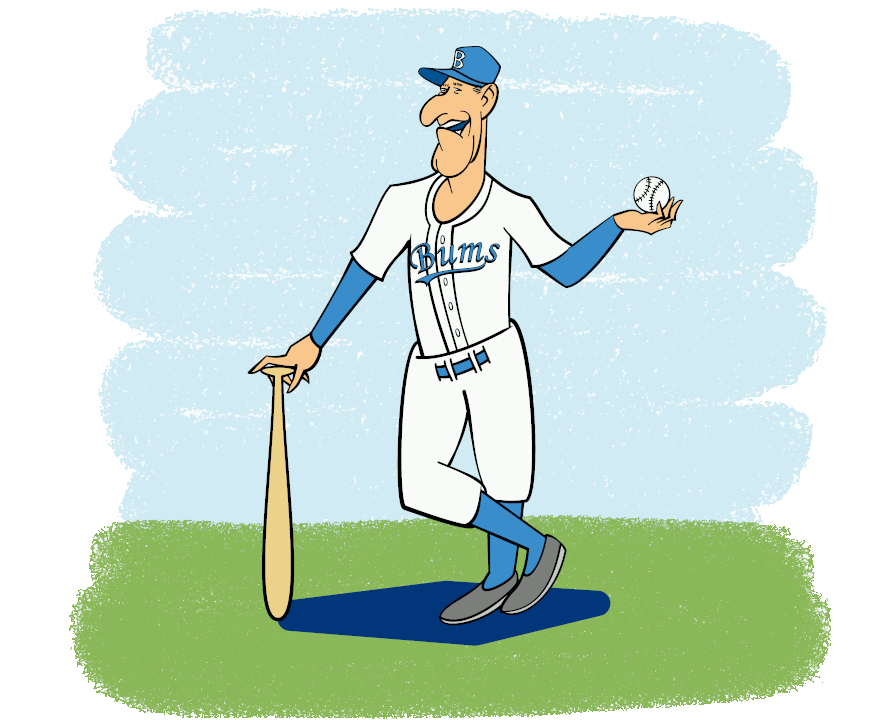
Leo Durocher
It wasn't him.
(Click to zoom in and out.)
The trouble was that Phil was one of the smallest players around. On a good day his heft was 160 lbs and he might stretch to 5'6". As a teenager he was noticeably smaller and was even referred to as "Shrimp".
But then in 1937 - Phil was now nineteen - he decided to join the Yankees. After the tryouts the head scout Paul Kritchell and coach Art Fletcher thought "the little one" was good. He was quick and could field. They told Joe McCarthy - the Yankee's even then legendary manager - that they should put the kid in at shortstop. Joe replied he was too small for Yankee Stadium. But Paul said he was big enough.
So Paul went to Phil's home with a contract. Phil's dad Fiore (also called Phil) had always been a bit dubious of his son's sports ambition. But his wife, Rose (short for Rosina), always had taken young Phil's side. Since Phil was too young to legally sign a contract, Rose did.
Naturally, Phil had to put in a stint in the Yankees' farm system. Paul told Phil he could go to the Butler Yankees in Pennsylvania or the Basset Furnituremakers - yes, that was the team's name - in Virginia. Phil opted for Basset.
Basset, we must point out, was a Class D team and after a year Phil moved up to the somewhat more cosmopolitan Virginia Tars in Norfolk which was a Class B team. The classification levels are not necessarily a comment upon the quality of players or the team but instead are based on the population of the home city. But as the population also determines the salaries of the players, for all practical purposes the earlier letters indicate a team of a higher status.
Honesty compels us to say that the stories of Phil's career vary a bit. In some tellings, Phil joined the Furnituremakers but they weren't a farm team for the Yankees. Instead they were an independent minor league team. It was after playing in Bassett that Phil tried out for the Yankees as a free agent. However, a popular informational reference work states the Furnituremakers were at least "associated" with the Yankees beginning in 1936 and so were officially part of the organization's farm club system.
On the other hand there are stories that tell that after Phil left the Furnituremakers he went to play for the Kansas City Athletics, a major league team. But then the Yankees would "poach" their players and so making the Athletics a de facto if not de jure Yankees farm club.
Here, though, there seems to be some confusion of the Kansas City Athletics - which were indeed a major league team - with the Kansas City Blues. From 1936 to 1954 the Blues were a minor league team associated with the Yankees and Phil played for them in 1939 and 1940. This was a Class A Team and so only a step below the majors.2
Footnote
The confusion between the Blues and the Athletics was made evident when Phil's daughter, Pat, appeared as a contestant on To Tell the Truth. John Cameron Swayze - the guy who used to do the Timex watch commercials - asked Pat (who was Contestant #2) if her dad ever played for Kansas City. She said no. Partly on the basis of this answer three of the panelists voted for Contestant #1 who happened to be John Lahr, later to be an award winning writer and theater critic and who was the son of Bert Lahr, the actor who played the Cowardly Lion in The Wizard of Oz. When the panel asked Pat why she said her dad didn't play for Kansas City she said she just forgot.
But even then if you just said "Kansas City" it was understood that you were referring to the major league Athletics and not the minor league Blues. So it seems that John was indeed confused and thought Phil had played for the Athletics. So Pat's answer was correct.
Contestant #3, by the way, got no votes. He was Mike Collyer, the son of the show's host and presenter, Bud Collyer.
Phil played shortstop through his entire career and if you see see the rankings comparing the various stoppers the statistics seem perplexing. You see the usual stuff: batting average, home runs, on-base-percentage, runs batted in. But what does that have to do with catching balls hit between second and third base?
The true measure of a shortstop is how many balls he fields and how he sets up double and triple plays. And no less a personage than Joe DiMaggio - who played centerfield - said "The little guy in front of me, he made my job easy. I didn’t have to pick up so many ground balls." Phil's 1,217 double plays may seem low by today's standards, but when he retired it was the second highest in MLB history.
Today there is discussion on whether Phil merited his induction into the Hall of Fame. The detractors - which include some Yankee fans - point out he had only 38 career home runs and 561 runs batted in (compare this to Baltimore's shortstop Cal Ripken, Jr., with his 431 homers and 1369 RBIs). They point out that Phil's election was not from the writers' votes but from the Veterans committee which included his former teammate Yogi Berra and fellow shortstop Pee Wee Reese. Also Phil was elected almost thirty years after he retired as an active player. C'mon! If Roger Maris isn't in the Hall of Fame why should Phil be there?

Roger Maris
Not in the HOF
(Click to zoom in and out.)
But Phil's fans point out that it was his overall contributions to the Yankees' success that merits his inclusion with the Dynamos of the Diamond. Simple statistics belie his importance to the Yankees's success. For one thing, people who point out Phil's lowly 38 home runs neglect to mention that at that time shortstops were not necessarily expected to be great hitters. It was their job to stop runners from getting on base.
But at the plate Phil was no slouch. He was master of the bunt, a hitting technique which is of considerable value to a team but adds little - and even detracts from - a player's statistics. A bunt is where the batter holds the handle of the bat with one hand and the top with the other. The player then tries to gently tap the ball so it stays in the infield.
Unlike most hitting strategies, the bunt is not expected to get the batter on base. Instead the batter tries to direct the ball so it stays away from the infielders and creates the opportunity for the runners on base to advance. So a skilled bunter can be crucial to a team winning. But unfortunately for the batter, as only 2% of all bunts will be hits, the batter is almost always thrown out.
Phil, his champions also point out, was shortstop from 1941 to 1955 when the Yankees were in nine - count' em - nine World Series. They won seven. Phil was also on the team with the five unbroken World Series wins from 1949 to 1953.
In his peak year of 1950 Phil had 200 hits with a batting average of .324. That year he was also named the American League Most Valuable Player, edging out the likes of Bob Lemon, Yogi Berra, and Joe Dimaggio (!). Phil was on five All Star Teams including a four year run from 1950 to 1953. Today if you look at popular rankings of athletes and find a "Best Shortstops of All Time" list, in addition to Honus Wagner, Cal Ripken Jr., Derek Jeter, and Pee Wee Resse, you'll likely find Scooter stuck in somewhere.
Besides there is the one undeniable honor that merits Phil Rizzuto to be included in the Baseball Hall of Fame. That came on February 2, 1950. That was not only his peak year as a player but above all he had a unique distinction that never could or ever will be achieved by any other player - or person - in history.
 PHIL RIZZUTO
WAS THE
FIRST MYSTERY GUEST
ON
WHAT'S MY LINE?
No further discussion is needed.
References and Further Reading
The Scooter: The Phil Rizzuto Story, Gene Schoor, Atheneum, 1982.
"Phil Rizzuto Awards", Baseball Almanac.
"Phil Rizzuto", Lawrence Baldassaro, Society for American Baseball Reserch, January 4, 2012.
"Phil Rizzuto", Baseball Hall of Fame.
"Phil Rizzuto's Playing Career Ends", Cody Eding, Baseball Hall of Fame.
"Phil Rizzuto", Baseball Reference.
"Echoes of Phil Rizzuto as Don Mattingly Awaits Hall of Fame Verdict", Nick Power, SB Nation, December 5, 2025.
"Minor League Classification System", Baseball Reference.
"Bunt Baseball Full Guide - Definition, Rules, Techniques", Jason Butler, Honest Baseball, September 19, 2023.
To Tell the Truth, Bud Collyer (moderator), Pat Rizzuto (contestant), John Lahr (contestant), Mike Collyer (contestant), Phil Rizzuto (special guest), Polly Bergen (panelist), John Cameron Swayze (panelist), Hildy Parks (panelist), Dick Van Dyke (panelist), Franklin Heller (director), Gil Fates (producer), Mark Goodson (producer), Bill Todman (producer), CBS, January 15, 1957.
What's My Line, John Daly (moderator), Phil Rizzuto (mystery guest), Harold Hoffman (panelist), Dorothy Kilgallen (panelist), Louis Untermeyer (panelist), Richard Hoffmann (panelist), Lee Vines (announcer), Paul Monroe (director), Gil Fates (producer), Mark Goodson (producer), Bill Todman (producer), CBS, February 2, 1950.