Mario Lanza
(Click on the image to zoom in.)
First of all, when learning about the life and career of Mario Lanza, it's important to know that
 BECAUSE
Mario Lanza
Had One Of The
Greatest Operatic
Tenor Voices
In History
He Was Only In
TWO OPERAS.
Ha? (To quote Shakespeare.) Did you say that
BECAUSE
Mario Lanza
Had One Of The
Greatest Operatic
Tenor Voices
In History
He Was Only In
TWO OPERAS?
Indeed (also Shakespeare). We repeat.
BECAUSE
Mario Lanza
Had One Of The
Greatest Operatic
Tenor Voices
In History
He Was Only In
TWO OPERAS!
Thereby, of course, hangs a tale.
First of all, no, Mario was not Mario's name and neither was Lanza. He was born Alfredo Arnold Cocozza (pronounced coh-COH-tsah) in 1921 and his friends called him Freddie. His parents were Antonio Cocozza and Maria, née Lanza. So yes, professionally Mario borrowed his mom's name much as did a fellow named Pablo.
A Fellow Named Pablo
(Click to zoom in and out.)
And Mario - as we'll call him - was a Philadelphia boy. He was born in the Town of Brotherly Love1 and hometown to other famous singers. As was common with many who grew up in Philadelphia's Little Italy, Mario came from a music-loving family. His dad was an avid record collector and both parents encouraged their son's obvious talent.
From the City of Brotherly Love
Mr.Forte
Chubby
(Click to Do the Twist.)
But no, Mario was not "discovered" singing while loading pianos onto a truck as some armchair historians in Quaint American Towns have said. Instead his appearances in amateur opera productions brought him to the notice of one of the country's top conductors, Serge Koussevitzky. So it was no surprise to his friends and family when at age 20 he was awarded a scholarship to the Berkshire Music Center in Tanglewood, Massachusetts. Among Mario's fellow students at that prestigious organization were none other than a young Leonard Bernstein and a not quite as young Frederick Fennell.
Lenny and Frederick
Fellow Students
Lenny
Frederick
To be honest, if you count his appearance at the Philadelphia's YMCA production of Crispino e la comare Mario was in three operas. But it was at Tanglewood that Mario appeared in the Merry Wives of Windsor, the opera by Otto Nicolai (not the play by William). That was in 1942. An opera career was clearly in the making.
Merry Wives of Windsow
Not by William
But first there was a war on.
World War II, that is. Like many young Americans of his age and fitness, Mario went into the Army. With his background and ability, though, he was assigned to the Special Services Branch which provided entertainments to the troops. The rule of the Army was each man to his suitable station.
And there Mario was most suited. The Special Services had organized a traveling show On the Beam by Broadway composer Frank Loesser (who later wrote the words and music for Guys and Dolls and How to Succeed in Business Without Really Trying). Mario then was selected for the cast of Moss Hart's non-musical play Winged Victory which is about a bunch of recruits during training. Among Mario's fellow cast members were Red Buttons (prolific and largely comedic actor who appeared in The Longest Day, The Poseidon Adventure, and who won an Academy Award in Sayonara), Lee J. Cobb (co-star of TV's The Virginian and who performed in the title role of the first run of Death of a Salesman), John Forsythe (star of the popular series Bachelor Father, who appeared as detective Alvin Dewey in In Cold Blood, and was the voice of the never-seen Charlie on Charlie's Angels) , Peter Lind Hayes (popular entertainer along with his wife Mary Healy), Karl Malden (Academy Award winner in A Streetcar Named Desire, the warden in Birdman of Alcatraz, star of the detective series The Streets of San Francisco, and who played General Omar N. Bradley in Patton), Barry Nelson (the first actor to play James Bond), and George Reeves (star of television's The Adventures of Superman).
Of course, like many soldiers Mario enjoyed the company of the ladies. While still in the Army, he met Betty Hicks, the sister of an Army buddy. Seeing no reason to wait, they got married in 1943 and ultimately had four kids: Colleen, Elisa, Marc, and Damon.
Immediately after the Japanese surrender Mario sang in a concert with the NBC Symphony Orchestra and then embarked on an extensive concert tour that continued into 1947. It was the next year, 1948, that Mario appeared as Lieutenant Pinkerton in Madame Butterfly with the New Orleans Opera Association. As in his concerts he received rave reviews.
At this point, it needs to be mentioned that some scholars point out that Mario's role in the Merry Wives of Windsor at Tanglewood was just a student performance and was not a professional role. So you can argue that Mario performed only in one opera, Madame Butterfly, and that was in a role which critics have said has one of the least demanding tenor parts.
Nevertheless Mario was serious about an operatic career and he began taking voice lessons from Enrico Rosati, who was a well-known vocal coach. Enrico specialized in bel canto which is a type of singing that no one seems to know what it is although it means "beautiful singing". Mario also continued giving concerts.
And opera companies were definitely interested in the new singing sensation. As early as 1947 New York's Metropolitan Opera had asked him to perform with them, Other companies - the San Francisco Opera, the Royal Opera of England, and even La Scala in Milan - would later make offers.
So why only two operas for Mario?
Well, in 1947 one of his concerts had been at the Hollywood Bowl. There he was seen by movie mogul, Louis B. Mayer (yes, THE Mayer of Metro-Goldwyn-Mayer or MGM). At that time musicals were the hot Hollywood item. Opera had prestige, yes, but Hollywood had the money. Louis immediately signed Mario up to a long-term - and lucrative - motion picture contract.

John W. Bubbles
Sportin' Life
(Click to zoom in and out.)
There is another issue of relevancy regarding Mario's somewhat lackadaisical pursuit of operatic roles. Despite his ability to sing in virtually any musical genre, he never learned how to read music. Although scholars point out this was not necessarily a major problem - John W. Bubbles who originated the role of Sportin' Life in George Gershwin's Porgy and Bess couldn't read music either - nevertheless having to learn a full operatic part by ear could be a challenge for both the singer and the conductor.2
Footnote
When John W. Bubbles played Sportin' Life in Porgy and Bess, the reviews were virtually unanimous that he stole the show. John was a great singer and dancer but he did not read music nor was he used to the discipline needed for playing in a tightly choreographed opera. Alex Smallens, the conductor, found getting him ready for the performance both a challenge and exasperating. At one point during a rehearsal Alex turned to John and with considerable sarcasm said, "Maybe the fault is in my conducting?" John replied completely sincerely, "Mr. Smallens, if I had the money of the way you conduct, I'd be a millionaire."
But movies are particularly suited for a musical non-reader as the parts - and songs - could be filmed a little bit at a time. So the actors only have to learn the scene scheduled for that particular day and it's up to the film editors to put everything together. But best of all if you flub a line, you could reshoot.
And if you flubbed a song? Well, no problem. Songs in movies are often recorded in advance. The actors can sing during filming - which might make the singing look more realistic - but what the audience in the theater hears has likely been dubbed in.
So for Mario the movies definitely had their advantages over stage productions, and for the next ten years Mario starred in a succession of films. The first was That Midnight Kiss (1949) and it was a hit. Then in short order Mario was cast in The Toast of New Orleans (1950), The Great Caruso (1951), Because You're Mine (1952), The Student Prince (1954), Serenade (1956), Seven Hills of Rome (1957), and For the First Time (1959). Mario usually played a singer who naturally has a love interest. Despite the trials and tribulations the pair encounter, eventually things work out well for all.
Two movies are worth special mention. One of course is The Great Caruso where Mario stars as (who else?) Enrico Caruso. The film portrays the basic drift of Enrico's life but inevitably for a Hollywood biopic there is much screenwriter's invention. According to one popular informational reference, the Caruso family was not pleased with the libertates facti taken in the script and they were able to temporarily block the film from being shown in Italy.
And the other movie of note? Well, that was The Student Prince. But more on that later.
Although Mario had hoped to balance his movies with operatic performances, this was difficult with the realities of making movies and the hectic scheduling required. So between films Mario mostly occupied the space with concerts and making recordings.
From the first Mario had been cutting records, both classical and popular. And he was a smash. In 1950 "Be My Love" sold a million copies, and even his classical records sold well. In fact, Mario was the first singer to have Gold Records in both the classical and popular genre.
Based on sheer numbers alone, Mario evidently saw the recording studio as one of the best ways for the performer to reach his fans. Comprehensive discographies for Mario generally list over 400 recordings, and many of these are readily available today for the world's listening pleasure. Like many singers, he had a favorite musical director and this was the Italian-born conductor Ray Sinatra who had a second cousin living in Hoboken.
Ray's Second Cousin from Hoboken
(Click to zoom in and out.)
As the century hit its halfway mark, the natural path forward would be for Mario to have his own radio show. That came about with (what else?) The Mario Lanza Show. The program premiered on June 10, 1951, on CBS and was sponsored by Coca-Cola for over 50 episodes. And yes, Mario did appear on television in guest appearances and for interviews. But he never had a TV show of his own.
We mentioned Mario was in The Student Prince and the film is worthy of comment. It is in fact unique in Mario's movies in that you never see Mario. Instead, it was his voice that was the star of the show.
What happened was Mario was becoming dissatisfied with MGM who he felt had insisted on too restrictive terms in his contract. But he also had what might be called irreconcilable artistic disagreements with the director. So when shooting began there were difficulties.
It's not quite clear whether Mario left on his own or was replaced. But in any case the role on the screen was taken over by the English actor, Edmund Purdom. Edmond, we must point out, was very busy that year and immediately went on to star in the swords and sandals extravaganza The Egyptian along with Jean Simmons, Victor Mature, and Peter Ustinov.
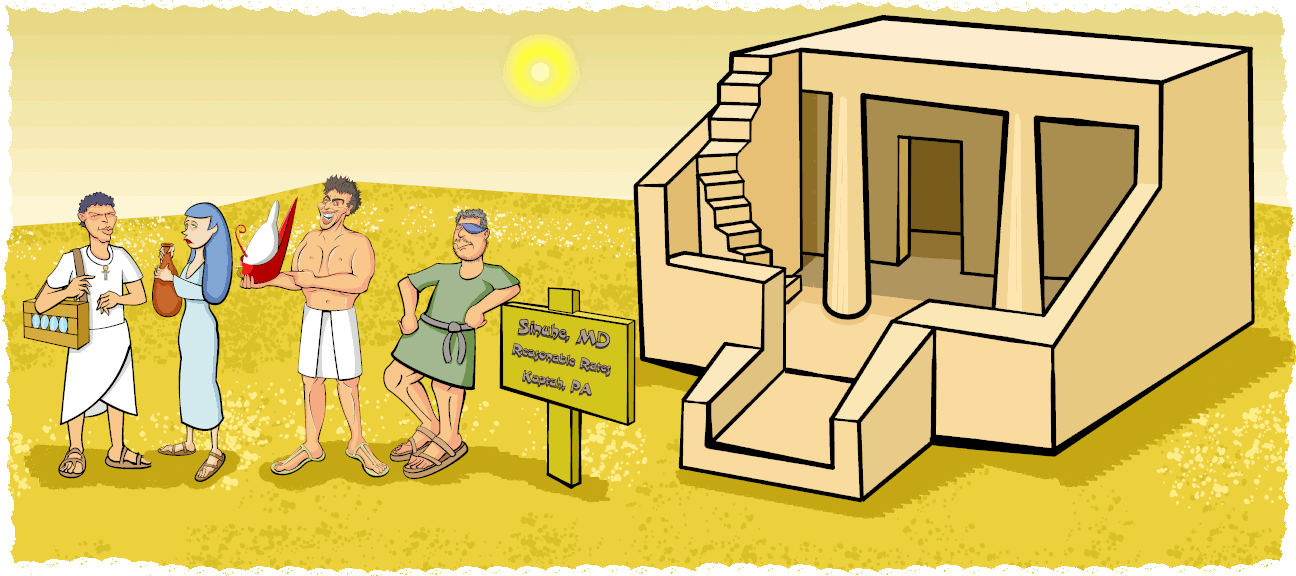
The Egyptian
Edmund, Jean, Victor, and Peter
(Click to zoom in and out.)
Of course, Edmond couldn't sing - at least not as good as Mario. But with the Hollywood practice that all of the songs had been recorded before the filming, Mario's voice was dubbed in for Edmond's lip-syncing.
But Mario's name was the big draw. So the movie posters all proclaimed that you heard
The Singing Voice
of
Mario Lanza.
But in any case, whether because of Mario's singing or Edmund's leading-man chiseled features, The Student Prince was a success, certainly financially.
But yet for all his success in Hollywood and his recordings, Mario was still hoping to pursue a true operatic career. So beginning in 1959 he went to Italy specifically to perform in Italian productions. He was still young - 37 - and he seemed determined to move away from Hollywood.
However, as did many of his generation, Mario did not practice the best of health habits. Not only did he enjoy a good and ample meal - and we mean a GOOD and AMPLE meal - and if some stories be true he enjoyed the conviviality imparted by the fine Italian vinos. Such habits tended to add extra heft to what was naturally a stocky frame. So for his films he would have to slim down quickly and to this end he would indulge in crash diets and what are now considered fringe treatments.
There had been definite warning signs. Only a year before Mario had not been feeling well and admitted himself to a sanatorium near Walchensee in the Bavarian Alps. There seemed to have been some improvement, although the doctors urged him to cut back both his eating and drinking. However, his schedule remained as hectic as before and after making his last film, For the First Time, Mario entered into a weight loss program at the Valle Guilia clinic in Rome.
The earliest news stories reported that Mario had died on October 7, 1959, in Rome. Some accounts state he was still at the clinic. But others say that he had just been discharged and was rushed back after he suffered a heart attack. Since a possible contributing cause was Mario's crash diets, doctors began cautioning the readers against such on-again-off-again eating regimens.
The early reports notwithstanding, the exact cause of death was never established. Similar symptoms could also have been due to a cerebral hemorrhage due to hypertension (Mario did have high blood pressure). He also suffered from phlebitis which is inflammation of the veins (often in the leg) when a blood clot forms. Although phlebitis can be treated, in some cases the clot can break free resulting in a pulmonary embolism.
Lucky
They never met.
Naturally there have been conspiracy theories including the inevitable it-was-a-Mafia-hit due to some ill-defined slight against the Mob. One mainstream news outlet even published an article that claimed Mario had run afoul of Salvatore Lucania - better known as Charles "Lucky" Luciano - because Mario had refused to perform at a mob-sponsored gala party. The story even claimed that Mario was found with an intravenous drip still in his arm. Naturally this is bullshine, balderdash, and poppycock. The truth is there's no indication that anyone in La Cosa Nostra had any beef with Mario, and as far as anyone knows Mario never even met Lucky.
During Mario's lifetime critics usually gave high praise to his concerts. Today, though, some of the grumpier commentators like to downplay Mario's importance. Then there are others who lament that his talent was "wasted" by making so many movies. Still others might argue he just wasn't really all that great. Or something.
However, many of the top singing stars have cited Mario as a major influence. We're talking about the likes of Luciano Pavarotti, José Carreras, and Plácido Domingo.
Oh, yes. And someone named Elvis.
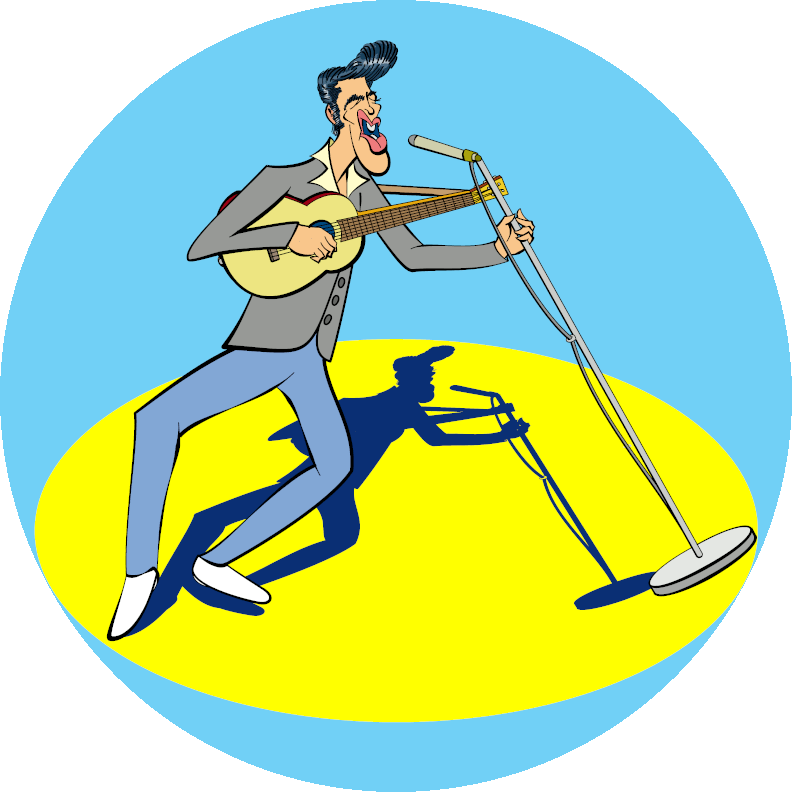
Someone Named Elvis
(Click to zoom in and out.)
References and Further Reading
Mario Lanza: A Biography, Derek Mannering (Author), Jose Carreras (Foreword), S&B Publishing, 1992.
Mario Lanza Tenor, https://www.mariolanzatenor.com/.
"The Mario Lanza Show", Radio Echos.
"Reassessing Mario Lanza", Lynn René Bayley, The Art Music Lounge, July 18, 2022.
"Super Mario: The Operatic (and Boozy) Tragedy of the Great Mario Lanza", February 8, 2021.
"Mario Lanza , Golden Tenor , Dies in Rome", Associated Press, Daily Illini, October 8, 1959
"What Liz Wants, Liz Gets", Shiela Graham, Hollywood, Washington [D. C.] Evening Star, p. D-11, October 21, 1959.
"Friend Dies After Viewing Lanza's Body", Associated Press, The Key West [Florida] Citizen, October 18, 1959, p. 4.
"Mario Lanza/October 1, 1959 - October 31, 1959", Chronicling America, Library of Congress.
Mario Lanza In Concert - Royal Albert Hall, Mario Lanza (singer), Constantine Callinicos (Piano), Recorded January 16, 1958.
"Reassessing Mario Lanza", The Art Music Lounge, July 18, 2022.
"Mario Lanza Reassessed", Derek McGovern, Opera Vivra, November 1, 2016.