Tom Gorman, Jen Pawol,
and Emmett Ashford
(Click on the image to zoom in and out.)
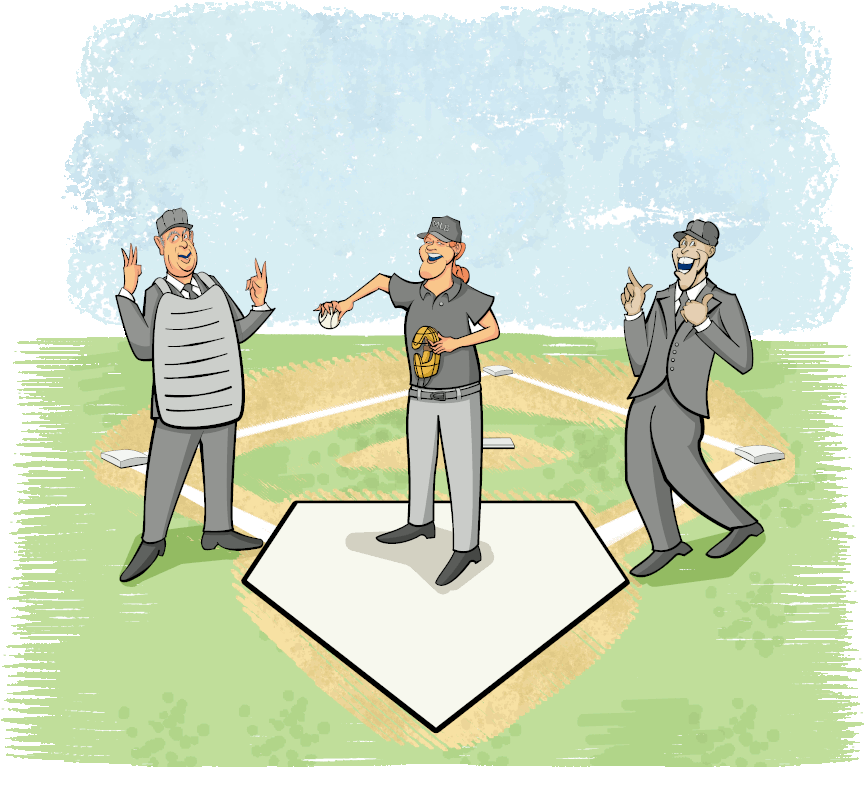
I never questioned the integrity of any umpire. Their eyesight, yes.
- Leo Durocher.
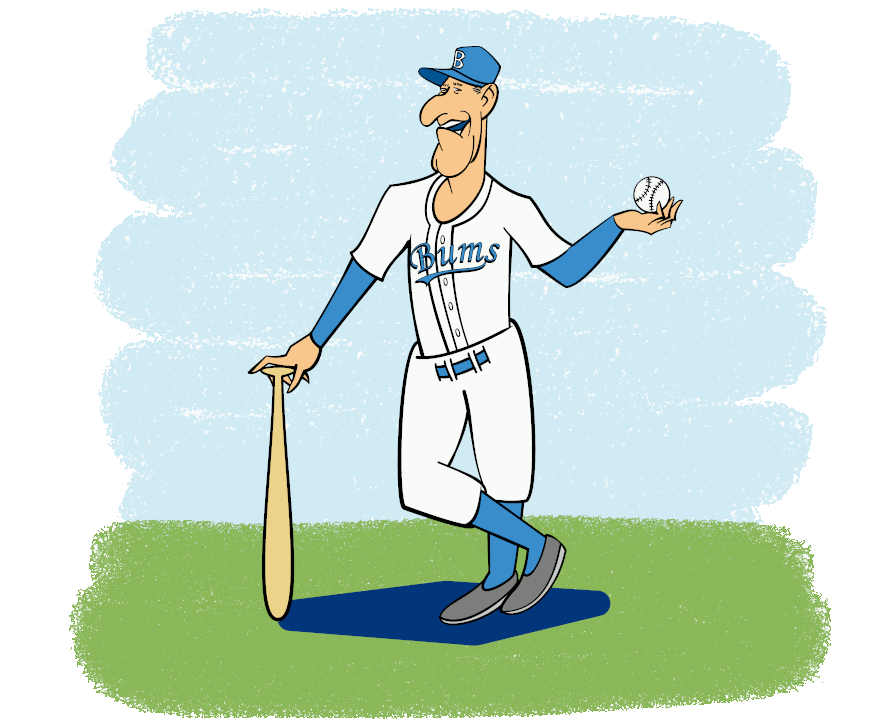
Léo le Lèvre
(Cliquez sur l'image pour effectuer un zoom avant ou arrière.)
We have to admit it. Leo could be a bit tough on umpires.1 But at least in his famous memoirs, Nice Guys Finish Last, he never wrote anything critical of Tom Gorman or Emmett Ashford. And of course, he never met Jen Pawol.
Footnote
In Nice Guys Finish Last, Leo's complained that the quality of the officiating was, well, let's just say it did not meet his expectations. He said that one umpire - who we will not name although Leo did - would call strike if the ball that passed the batter at neck high. But if it was right over the plate and down the middle, it was a ball.
Leo also felt the early umpires were more willing to listen to a manager or player in questioning a call. It had been all right to go to an umpire and ask him to consult with the other umpires if his call was correct. If the others said the umpire's judgement had been in error, then they would correct the call. But in later years Leo said that he once asked for a reassessment and the head umpire agreed that Leo had been correct in disputing a call. But he wasn't going to contradict a fellow umpire and so he let the call stand.
Leo also lamented the thinness of the skins of the newer play-callers. In the old days, you could argue with an umpire and he'd let you have your say. But later if you just came out of the dugout, you'd get tossed out of the game. Leo, we must point out, had a reputation of both arguing with umpires and getting ejected.
At present Leo ranks #3 behind Bobby Cox and John McGraw in the number of times ejected from a game. However, part of this metric is due to Leo's duration in the game. With 100 ejections out of 3739 games - a mere 2.67% - Leo isn't even in the Top 10.
Jen is the first woman to serve as a major league baseball umpire in a regular season game.2 She was the home plate umpire at the game between the Atlanta Braves and the Miami Marlins on August 10, 2025 in Atlanta.3
Footnote
However, strictly speaking Jen is the not the first woman to serve as a professional umpire. Ria Cortesio, Christine Wren, Pam Postema, and Bernice Gera were umpires in the minor leagues. Perry Barber has been umpiring since the early 1980's and has officiated at major league spring training games.
Footnote
The Braves play at Truist Park which strictly speaking is in Cumberland about 10 miles northwest of downtown Atlanta.
Like all MLB umpires, Jen first worked in the minor leagues. She began officiating in 2016 and a nine year stint prior to transitioning to the majors is pretty much par. By all accounts, minor league officiating isn't a bed of roses. With games every day the economics of the minors dictates most travel is by car and accommodations can be rudimentary. One major league ball player said they eat different steaks in the minor leagues. Another player said they were lucky to get hamburger.
Emmett Ashford was the first black major league umpire. While working in the post office in the late 1940's he began officiating part time in the local amateur games. His congenial personality and distinctive style of calling made him a crowd favorite and in 1951 he was invited to join the minors in the Southwest International League. He then moved to other leagues and wound up in the prestigious Pacific Coast League in 1954. In 1963, Emmett was appointed umpire-in-chief for the Pacific League and then in 1966 he began umpiring in the majors for the American League.
Although some people commented that Emmett's flamboyant style worked against him - the usual rule is a good umpire is never noticed during the game - he was popular even with the owners and managers. Earl Weaver, known for his many umpire arguments and subsequent ejections, would speak calmly with Emmett during a questionable call. Even Charley Finley, the notoriously cantankerous owner of the Oakland Athletics, specifically requested that Emmett call the first game in the first game at the new Oakland Coliseum.4
Footnote
With their facial hair and quasi-old-timey uniforms, the A's under Charlie was one of the more colorful teams of the Sixties and Seventies. One of the A's best pitchers was Jim "Catfish" Hunter. The fans learned he picked up the sobriquet when he as a kid. He had played hooky from school and went fishing. Then when he was coming home a string of catfish his friends dubbed him his "Catfish".
Years later Catfish said the name was really given to him by Charley Findley as a publicity ploy. Charley told him that on the team he was going to be called "Catfish". Then Charley made up the story in case anyone asked how he got the nickname.
Tom Gorman, though, was one of the mainstays of Major League Baseball during the most important era - that is, the Rise of Televised Sports. He moved from the minors to the majors in 1956 and called games until his retirement in 1974.
Tom became better known to the general public when he appeared on a commercial with none other than Leo Durocher. It was an advertisement where two sports figures swore to use a particular brand of razor blades.
So when the commercial started you saw Leo and Tom facing the camera. They then took the pledge.
Leo: "I, Leo Durocher ..."
Tom: "I ,Tom Gorman ..."
Leo: "Switched to G-ll-tt- Pl-t-n-m Pl-s Blades."
Leo: "They are smoother and give me more comfort."
Tom: "It's as plain as the nose on your face."
Leo: "He never could see."
The announcer then breaks into the commercial and Leo steps in.
Leo: "Tom, throw him out of the commercial."
Tom then motions with his thumb and says:
"You are gone!"
So we see that even umpires have a sense of humor. So surely they won't mind a few good natured jests at their expense.
Why did the umpire work on a chicken farm in the off season?
So he could practice calling fowls.
Why do umpires never talk with managers on the telephone?
They're afraid the manager will ask them to reverse the call.
And then there's:
What did the umpire say to the bald-headed manager who began to argue with him?
"You're outta hair!"
References and Further Reading
"Tom Gorman", Bob Hurte, Society for American Baseball Research, January 4, 2012.
"Emmett Ashford", Mark Armour, Society for American Baseball Research, January 4, 2012.
"MLB Umpire Jen Pawol: Baseball America's 2025 Trailblazer Of The Year", J.J. Cooper, Baseball America, December 11, 2025.
Nice Guys Finish Last, Leo Durocher, Simon and Schuster, 1975.
"Umps and Champs", Donald Hall, The New York Times, April 15, 1979.
Leo Durocher: Baseball's Prodigal Son, Paul Dickson, Bloomsbury, 2017.