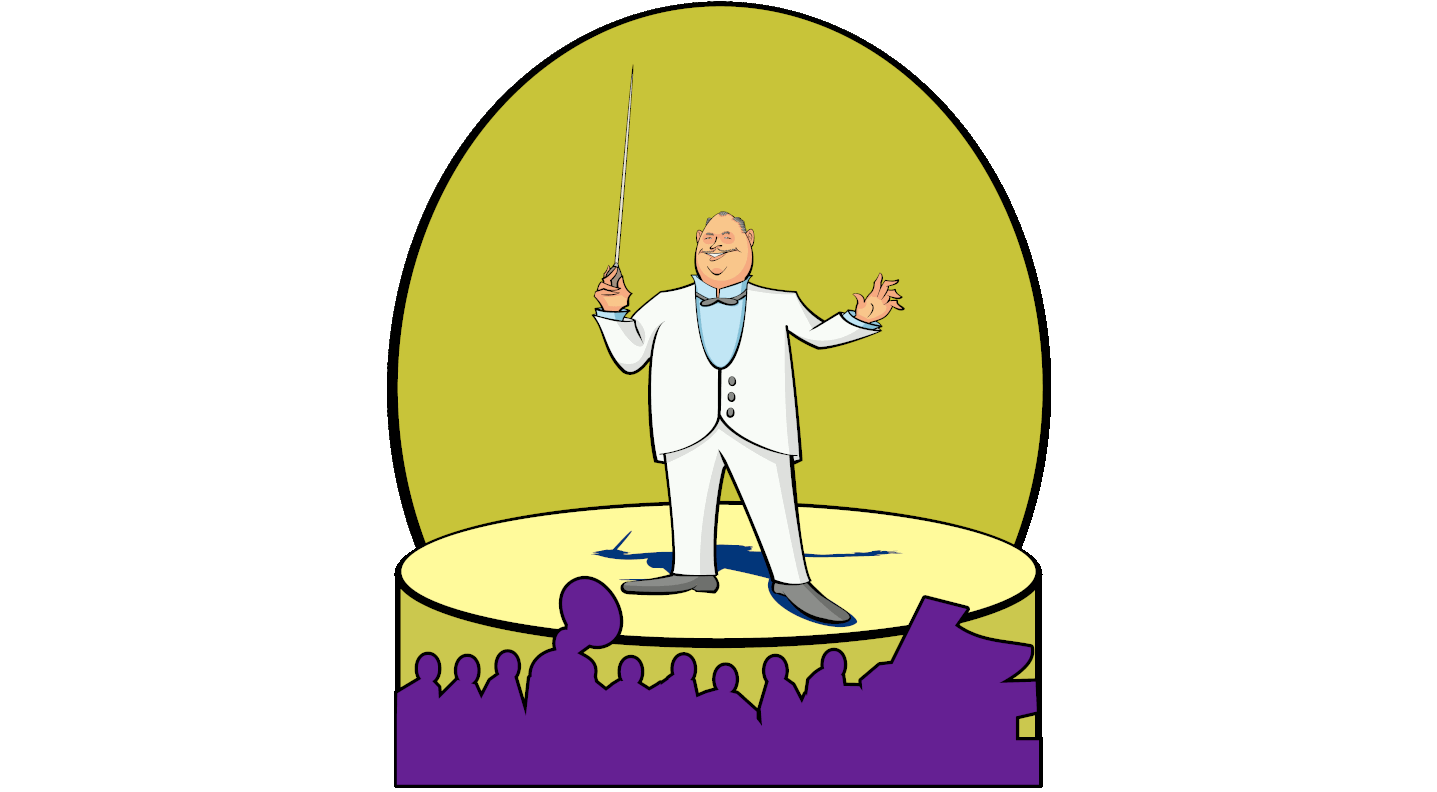
Today a mention of Paul Whiteman is so uncommon as to require considerable elaboration. But at one time the name was so familiar as to require no introduction.
Certainly if you start writing about someone who was born in Colorado in 1890, who by the age of ten was a crack rifle shot, was a constant truant from school, rebelled against his family's teachings, and had runs-in with the law before the age of 16, you'd think you might be reading about the last of the Old West outlaws.
Nope, you'd be reading about Paul Whiteman who is one of the most important - although now little known - popular band leaders of the early 20th Century. Billed as "The King of Jazz", Paul is arguably the one band leader who took what had been one of the first moral panics of the 20th Century and turned it into one of the most mainstream and honored musical genres.
In this day and age when jazz has become the quintessential American music, been played in Carnegie Hall and before Kings and Queens, and in fact is considered corny by young people (a sure sign of mainstream acceptance), it's easy to forget that jazz was once considered the harbinger of the fall to modern civilization. As late as 1920, you could find jazz labeled as junk, mumbo-jumbo, pernicious, blighting, and it appealed only to the shallow-minded, the unthinking, the lazy, and the shiftless. It was jazz, we were assured, that was a major cause of marital discord.
Paul changed that. Once he and his band caught the nation's ear, jazz was respectable, sophisticated, and was America's true contribution to world culture. After Paul came on the scene, anyone could listen to jazz and without censure.
True, scholars of American popular music might draw umbrage to anyone claiming that Paul is not well known. Well, next time you're out on the street, politely stop a passer-by and ask him if he had ever heard of Paul Whiteman. Then ask them if they've heard of someone named Elvis.
Nevertheless there are other and respected scholars who pooh-pooh Paul's importance. They maintain jazz was on its way to respectability anyway without foisting a watered-down imitation that wasn't even jazz. Certainly Paul's influence can't be compared to the likes of Louis Armstrong, Duke Ellington, Ella Fitzgerald, Jack Teagarden, Alberta Hunter, and Cab Calloway. They were the innovators. Paul - at best - was a mere (ptui) popularizer.
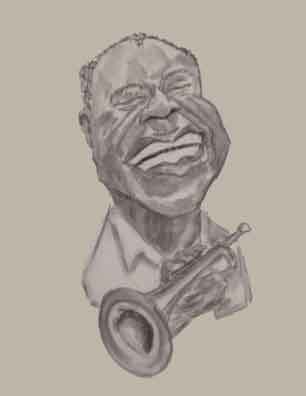
Louis
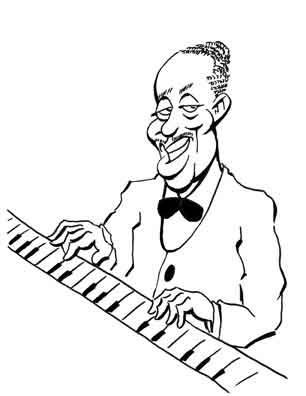
Duke
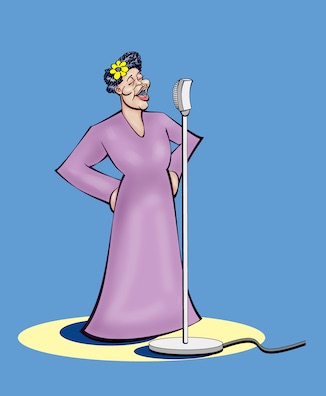
Ella
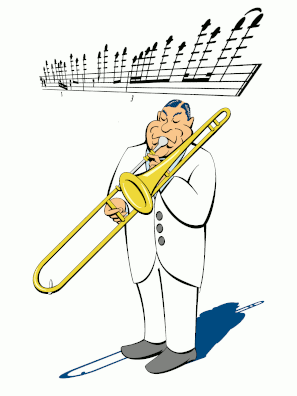
Jack
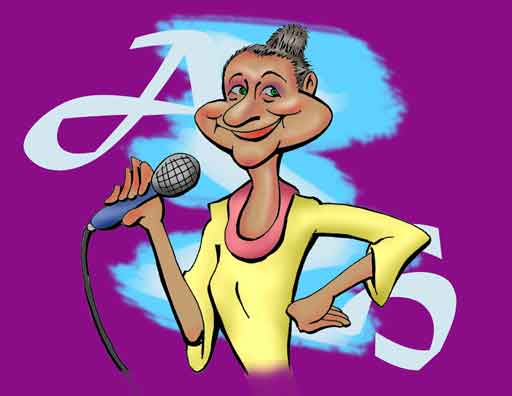
Alberta
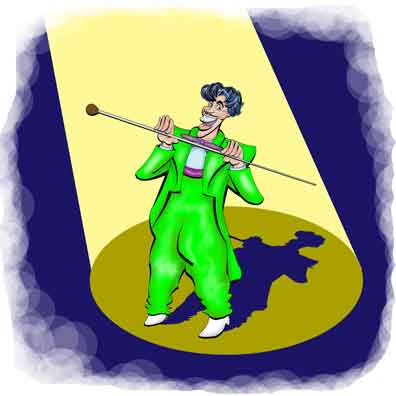
Cab
Paul was born March 28, 1890, to Elfrida (née Dallison) and Wilberforce1 Whiteman in Denver, Colorado. It was a musical household and Wilberforce was a music teacher in the public schools. Naturally he was pleased at his son's talent (particularly for the violin) but exasperated by the boy's aversion to practice. This (and other) disagreements remained a characteristic of homelife chez Whiteman.
Footnote
Yes, Wilberforce is a real name. It is, of course, not particularly common now, but there are people currently bearing the name.
At the age of 12 Paul was stricken by a bout of typhoid fever which thinned his hair and during his recovery induced a voracious appetite. Of course, Paul was naturally hefty and by the time he was fifteen, he towered over six feet and was pushing 180 pounds. But his hair never completely grew back and he maintained a craving for food that only lavish meals could ameliorate.
Paul learned both the violin and the viola. Although still a teenager and despite his lackadaisical approach to practice, he played well enough to land paying jobs. This was, of course, a time when good music had to be live music and in Denver - even then a quite cosmopolitan town - there were ongoing demands for skilled musicians. By age 17 Paul was a violinist in the Denver Symphony Orchestra.
Of course, Wilberforce having a nervous breakdown when Paul was 16 did little to ease the philosophical differences between father and son. After Paul graduated from high school and although not yet 18, he asked to be allowed to go to New York City where there were better opportunities for performing musicians and could also get him out of the house.
Wilberforce advanced the train fare only to express surprise when Paul soon showed up back home. He was even more surprised when he got a letter from an attorney that Paul's marriage to a lady named Nellie should be annulled. Naturally Wilberforce was flabbergasted but took steps that the marriage - if there really had been one - was dissolved.
Paul had continued to live at home but by 1915 his and Wilberforce's dealings had become so testy that Paul finally moved out. He headed to San Francisco where he sort of auditioned for the San Francisco Symphony. That is, he would sit in the hotel lobby where the orchestra's manager was staying, and when the manager walked in, Paul would begin to play.
This rather unorthodox approach didn't get him a job in the Symphony but it did land him a seat in another orchestra that was playing for the duration of the Panama–Pacific International Exposition that was held in San Francisco from February 20, 1915, to December 4.2 Then after the Exposition ended, Paul was offered a job playing viola with the SF Symphony
Footnote
The Panama–Pacific International Exposition of 1915 was an example of the once popular but now virtually extinct phenomenon called a World's Fair. World's Fairs were collections of exhibitions from around the world that were set up for visitors to come in and see the Wonders of the World. Inevitably there were places to go and see "The World of the Future" which never seemed to happen as predicted.
The World's Fairs had been a gradual development from the 18th Century but really began in the modern sense in 1851 with the opening of London's "Great Exhibition" in the now vanished Crystal Palace which had been constructed under Prince Albert's supervision in Hyde Park. Although technically World's Fairs are still around, for all practical purposes they ended with Expo 67 in Montreal.
But in 1915 the World's Fairs were big. Visitors to World's Fairs included dignitaries like Theodore Roosevelt, Kaiser Wilhelm of Germany, Admiral George "Fire When Ready Gridley" Dewey, and General Nelson A. Miles who had taken over George Custer's job after the Battle of the Little Bighorn. From the opening on May 1 until it closed on November 2, over 18,876,438 million people attended the San Francisco Exposition. Tickets cost 50¢
But playing in the Symphony was not exactly a full time job and in 1917 Paul organized his own 7 piece combo to play at a local roller rink. At this time there were no sound systems and people liked skating to music as much as they do now. Paul also played in groups that provided dinner music in the better hotels. All in all Paul was making a living.
But just barely. Then Paul began hearing about this new music called jass although perhaps due to the obvious and discourteous pun, it was soon being called jazz. Paul heard that if he would drop the viola and stick to the violin he could make twice as much money playing jazz fiddle than playing in the Symphony.
Alas Paul's first foray into being a professional jazzman was not successful. He wrangled a job playing with the band at Tait's Cafe but after two days the leader told him he didn't have the wherewithal to play jazz. Rather than discourage him, the comments put some pepper in his tail and Paul began going to all the clubs along the water front - the rather disreputable Barbary Coast - and studied the music and the techniques.
Paul liked jazz but noted that the musicians didn't write their music down. In fact they just made it up as they went along - "improvising" they called it. So if you heard and liked a tune you couldn't go out and buy the sheet music. In fact, the jazz musicians themselves might not play a song the same way twice. And if you had a band with multiple instruments each with their own parts, forget it.
Paul became convinced you could put jazz on paper and make it sound as good as the improvised tunes. So he began to write down what he heard as best he could and began putting together his own arrangements. By 1918, he had pulled together a group of musicians who agreed to play what he had written. Then with some seed money (provided by his sister) Paul set about trying to audition for the clubs, cafes, and hotels that wanted music.
The new group didn't last long nor through lack of ability but because there was, after all, a war on - World War I, that is. Actually Paul had tried to join up earlier but the recruiters told him his girth - now ballooned up to 300 pounds - made it unlikely he would be useful in the trenches or anywhere else for that matter. But finally after much effort and pestering, Paul got the Navy to take him on for "limited service" as a bandmaster.
By now Paul knew plenty of musicians and he organized a group called the Naval Training Camp Symphony. They played for recruiting drives and other military functions but after four months they had pretty much shot their venues. Paul's heft still kept him from actual combat overseas, so he was assigned to a submarine chaser off the California coast. But this assignment came to an end after there was a boiler explosion. He was reassigned back to his musical duties where he remained until the Armistice.
Which wasn't far off. It's often not appreciated that America's involvement in World War I was only a year and a half and so Paul's time in the Navy was measured in months, not years. However, the time gave him both experience and credentials as a band leader. He now had even more contacts than before and as 1919 got off to a start, an old musical friend, Rudy Siger, offered him a job as bandleader at the Rainbow Lane Room in the Fairmont Hotel. Paul could pick the band himself but Rudy suggested he use the trumpet player Henry Busse. Paul knew Henry and was agreeable.
Although in the group's hierarchy Henry was officially equal with Paul, Paul's presence - you couldn't miss him - made it inevitable he would soon emerge as the real leader. When the time at the Rainbow Lane ended, he began leading other groups up and down California. Naturally he came into contact with the critics who in general were impressed, one even calling Paul a "jazz musician extraordinaire". In Los Angeles he was soon making $650 a week which was divvied up in a cooperative agreement up among nine players - two parts for Paul and the others one part. So Paul was earning $144 a week and the others $72. That wasn't bad money.
As the group became more successful Paul had less time for arranging the tunes and turned the task over to others. He particularly liked the arrangements of a multi-instrumentalist named Ferde Grofé (pronounced FUR-dee grow-FAY). Usually Ferde would provide a first draft and Paul and the others would make suggestions.
Los Angeles, of course, also meant Hollywood. Even at that early date the small suburb was attracting movie producers and actors and they began patronizing Paul's performances. Soon the bigwigs began inviting Paul to their parties, both as performer and also as a guest.Then in 1920 a producer and director named Herbert Somborn and his wife (a lady named Gloria Swanson) heard Paul. Herbert had an uncle, S. W. Straus, who owned the Ambassador Hotel in Atlantic City. If they would come to the Ambassador, Herbert said, the pay would be $1200 a week for the group. However, the band had to pay their own expenses.
Things started off slow at first. The crowds stayed away and Paul began to think he had made a mistake. But gradually the few customers who trickled in began spreading the word about the hot new band at the Ambassador. Attendance ratcheted up.
Atlantic City, then as now, was a popular host town for business sojourns. When Summertime rolled in, the Victor Phonograph Company scheduled their yearly convention at Atlantic City and some of the executives stopped by the Ambassador. Although the recording business was just getting started, Victor had already emerged as the leader.
Accounts differ who signed the band up. Paul said it was a top executive but some band members remembered it was a lower level manager. In any case, the deal was that Paul would get $50 a side lump sum and the other band members $25. No royalties would be paid.
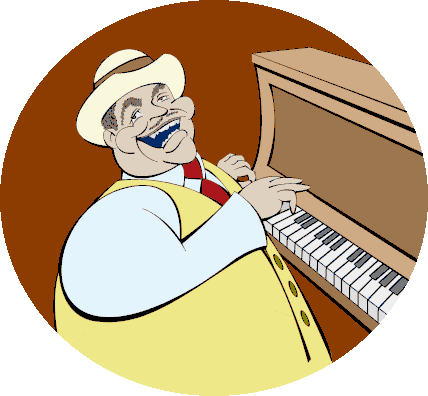
Fats
(Click to zoom in and out.)
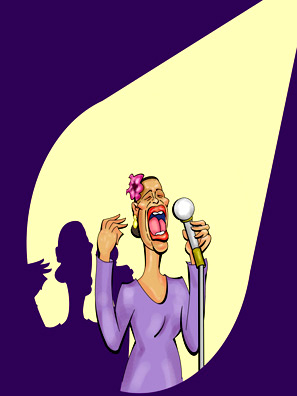
Billie
(Click to zoom in and out.)
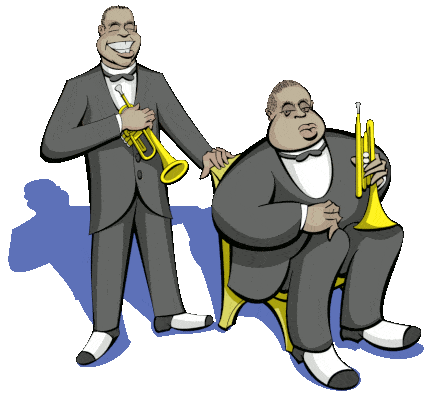
King Oliver (and Friend)
We have to admit it. Modern listeners who think of jazz in terms of Louis Armstrong, Ella Fitzgerald, Jelly Roll Morton, Sidney Bechet, Kid Ory, Fats Waller, Billie Holliday, Joe Oliver, and Bill Beiderbecke (who played with Paul) may think of Paul's earliest recordings as, well, a bit hokey. The arrangements are tightly choreographed with no hint at improvisation. The eighth notes are often of equal length and the harmonies are fairly simple giving the songs a boom-PAH boom-PAH boom-PAH sound (Paul's "Yes We Have No Bananas" has to be heard to be believed and even then you probably won't). The result is of someone trying to play jazz but not quite making it.
Of course, much of the music Paul played was simply popular tunes but not really jazz. "Yes, We Have No Bananas" is NOT jazz and some may say neither is "By the Waters of Minnetonka" or "Whispering".3 On the other hand Paul gives quite credible renditions of "Ain't Misbehavin'" "At Sundown", and even "The St. Louis Blues".
One type of song that Paul played and recorded was The Foxtrot. The foxtrot is actually a "ballroom" dance with the couple moving in close sweeping steps. The word, though, is also given to the music written for the dance. The tempo can be moderato around 90 - 100 beats per minute or and up-beat 136 - 160 bpm. So the melodies can range from the slow and languid to lively and bouncy. If you see an old film where an elegant couple are gliding over the floor it's likely a fox-trot.
To modern ears used to Dixieland, Chicago Style, Swing, Be-Bop, or Progressive, a foxtrot doesn't sound much like jazz. It's too smooth and even syrupy. However, scholars sometimes refer to the music as "sweet jazz", and as was stride piano can be considered as an intermediate style from that took ragtime music to true jazz.
It was in fact a foxtrot, "Whispering", that skyrocketed Paul to his national and later worldwide celebrity. It was one of the songs he recorded in 1920 and it sold over a million copies.
Soon Paul and his band were known literally from coast to coast. The size increased from the early combo or eight or nine players to literally a 35 piece orchestra with strings, brass, and woodwinds. They toured the country often with extended stays at the best hotel ballrooms. If the dancers wanted good music it still had to be live music, and Paul provided it.
This was also the era of the now largely defunct but at the time popular form of theatre, the music review. This was a collection of dancing and singing acts interspersed with comedy sketches and monologists which when put together could take up two hours or more of an evening. As many of the dancers were young somewhat scantily clad young ladies, the names of the shows might contain the words like "follies" and "scandals".
In 1922 Paul's popularity had reached the point where he had to turn down offers because he simply didn't have the time. But when the impresario, George White, made him an offer to appear in the Scandals of 1922 Paul couldn't turn down an offer to headline a Broadway show.
George White had been producing the Scandals since 1919. Now he had lined up a good show. In the line-up he had also managed to get the comedian Claude Dukenfield - who went by the name of W. C. Fields - as well as a new and upcoming songwriter named Jacob Gershwine who simplified his first name to George and his surname to Gershwin.
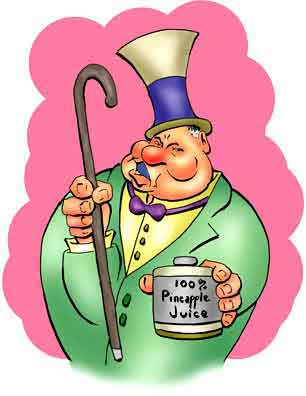
Claude Dukenfield
George knew of Paul's music from the band's extended runs at the Palais Royal and both men were happy to find themselves in the same show. Paul's performance of George's song "I'll Build a Stairway to Heaven" was one of the hits of the show.
Now Paul approached George with an idea - an "experiment" he called it. He asked if George could write a composition in the form of a classical piece for orchestra and piano, but one that would incorporate elements of jazz. At first George declined. He was too busy, he said, and couldn't devote the necessary time for such an ambitious work. So George thought that was that.
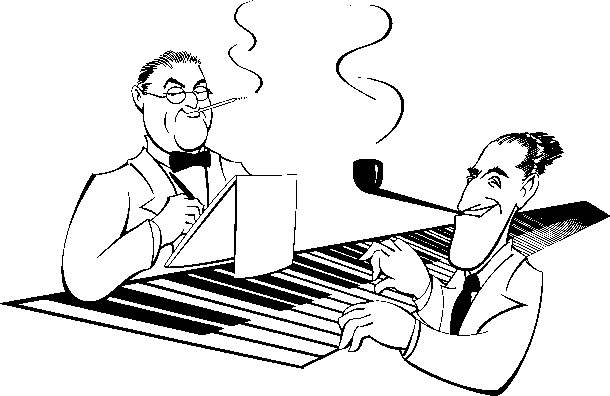
But when George's brother Ira pointed out a newspaper story that George was working on the piece and it would soon be performed, George felt he had better get cracking. To ease the burden, Paul said George wouldn't have to do the orchestration. Ferde Grofé would handle that.
The premiere of Rhapsody in Blue was February 12, 1924, at Aeolian Hall in New York with George at the piano and Paul conducting. Then on June 10, they cut a recording. The performance is a bit of a surprise to those who remember the tune with Leonard Bernstein at the piano while conducting the New York Philharmonic. Paul's clarinetist, Ross Gorman, plays the part with the opening glissando as if he's going for a joke, producing a honking sound imitating laughter. Although the playing is a bit jarring to modern sensibilities, it must have been OK with George since he was playing the piano.
The concert with Rhapsody in Blue did the trick. Jazz was now respectable and Paul and his orchestra were the vehicle for that respectability. Rhapsody in Blue was an instant classic and to this day is one of the most played examples of American "serious" music.
Leonard himself seemed a bit perplexed by the composition. He said that Rhapsody in Blue can be played for the full 12 minutes or it can be edited down to 5 and it's still Rhapsody in Blue. At least the song did mark George's entrance on the American scene as a serious composer even though previously he had been simply a songwriter cranking out 3 and 4 minute popular tunes.
As an aside, George loved playing the piano and could do so under almost any circumstances. Once George and some others were at a Bucks County farmhouse when publisher Bennett Cerf commented that the score for George's musical Pardon My English wasn't up to George's usual snuff. George disagreed. They were all sunbathing in the nude but George insisting on going inside, and he went through the entire score, singing and playing the piano, stark naked.
Harry Lillis Crosby
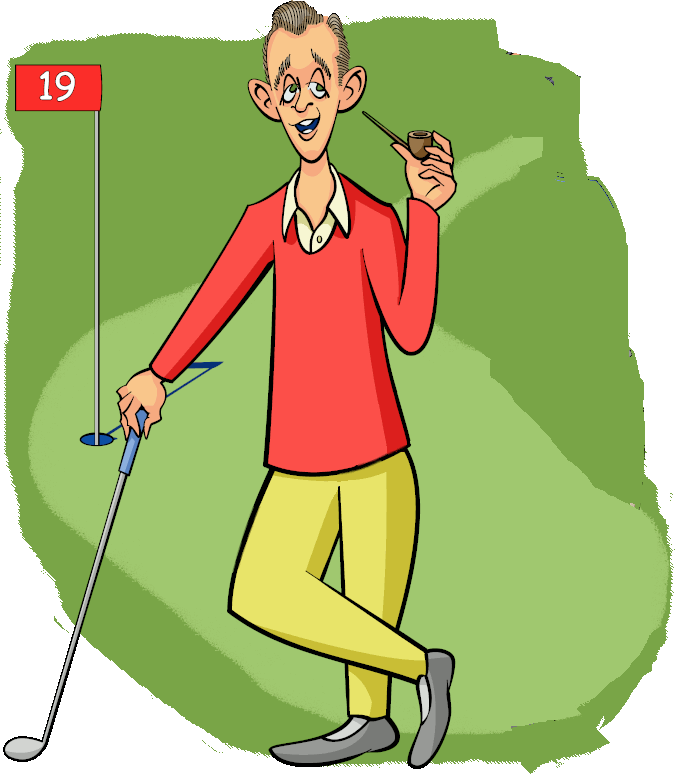
Of course, jazz wasn't just instruments all playing different tunes at the same time. There were also the singers. Among the vocalists Paul recruited was a sad-eyed young man with a smooth baritone voice and a low golf handicap named Harry Lillis Crosby. Bing - as he was known to his friends - proved to be an immediate hit. Paul soon supplemented Bing and his partner Al Rinker with pianist Harry Barris. Billed as The Rhythm Boys the group proved popular. As was common for singers in the bands, after a few years Bing moved on to a solo career and did pretty well for himself.
As the Roaring Twenties roared to an end, two changes in modern life became cemented into the World Culture. One was radio and Paul quickly capitalized on what soon became the #1 home entertainment. In the 1930's he hosted The Kraft Radio Hall, Paul Whiteman's Musical Varieties, and Paul Whiteman Presents. Literally everyone across the country was listening to Paul Whiteman.
Then there was cinema but now the pictures had sound. As you might expect of the King of Jazz, he appeared in a film titled (what else?), The King of Jazz (1930). This was followed by appearances in Strike Up the Band (with a plot totally unrelated to George Gershwin's musical), Rhapsody in Blue where Paul appeared with Robert Alda (yes, father of Alda "Hawkeye Pierce" Alda) (1940), and The Fabulous Dorseys (1947) where Tommy Dorsey was played by Tommy Dorsey and Jimmy Dorsey was played by Jimmy Dorsey. Art Tatum has a guest appearance as Art Tatum. and Paul played, yes, Paul Whiteman.
The trouble is the year 1930 was not only a time when jazz had become America's Music but it was also the beginning of The Great Depression. The good times of the Twenties ended, and not just for the average Joe and Josephine Blow on the streets. Paul himself felt the pinch. It didn't help that The King of Jazz had been a flop, and as bookings dried up Paul limited much of his performing to cafes and hotels. He relocated to Chicago and by then his third (!) marriage had dissolved and in 1931 he married his fourth wife, Mary Livingston. This time things worked out and they remained married for the next 36 years.
Of course, the Depression came to an end with the beginning of World War II. Paul did his best to continue performing but many of his present and prospective musicians were soon serving in the armed forces. But although staffing was difficult, in 1941 he jointed the cast of the Burns and Allen show which was one of the most popular programs on radio. Then in 1943, Paul became the musical director of the Blue Network which in a few years would assume the name ABC. Of course, if you were Paul Whiteman you had to have your own show and Paul hosted the Philco Radio Hall of Fame where he led the network orchestra.
However, the times as a Nobel Laureate would say were a-changin'. Ironically after the war the returning prosperity had made the big bands increasingly difficult to maintain. Recording technology had also improved to where good music no longer had to be live music. Music was less and less provided by a live studio band but was coming from pre-recorded platters.
But Paul Whiteman? What would the King of Jazz do if HE were asked to be a "disc jockey"?
Yep. He accepted.
Yes, Paul Whiteman, the King of Jazz, became a disc jockey although the show's name The Borden Music Review was soon switched to The Paul Whiteman Club. Amazingly Paul loved doing the show and he even enjoyed doing the commercials where the sponsors liked his folksy informal style with ad-libs thrown in. Paul played records of the big artists of the time (including Paul Whiteman), and he invited famous singers to appear live as guests. The show was a hit and Paul quickly realized that the era of the DJ was here to stay.
However, after about a year, the sameness of the show finally began to pall. Also changes made by the executives - such as having a separate announcer do the commercials - were followed by the show dropping in the ratings. Even though Paul was paid $800 an hour, he finally decided to move back to live performing.
It was inevitable, of course, but in 1948 Paul hosted a - yes - TELEVISION show, Paul Whiteman's Teen Club. It was based in Philadelphia and Paul let the local teens show off their musical talent. Paul supplied the music and the kids the vocals. Paul even had his own announcer, a young man named - get this - Dick Clark (yes, THE Dick Clark). Among the adolescent crooners that showed up were local Philly natives like Eddie Fisher, Bobby Rydell, Dion DiMucci (who soon dropped his last name), and a young lady from New York who attended Julliard and became one of Mitch Miller's favorite soloists, Leslie Uggams.
Dizzy
Charlie
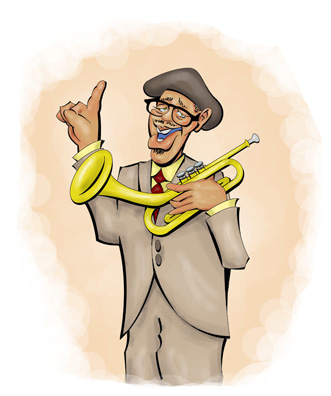
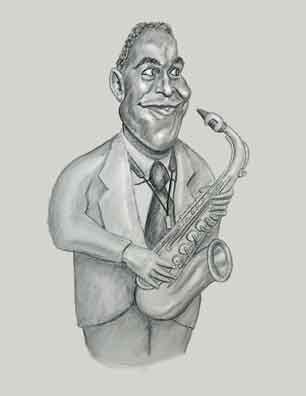
The times were a-changing indeed. Jazz had certainly a-changed. As the big bands got too big, jazz bands dropped to combos with three to five members. And the music had also a-changed. Under the guidance of musicians like trumpet player Dizzy Gillespie and saxophonist Charlie Parker the swinging toe-tapping dance tunes morphed to fast-riffs with irregular phrasing that soon became known as Be-Bop. Although die-hard fans remained loyal, jazz dropped from being one of the most popular musical genres to where it accounted for a mere 1% of all record sales.

Eddie, Johnny, and Bobby
(Click on the image to zoom in and out.)
Frankie!!!!!!!!
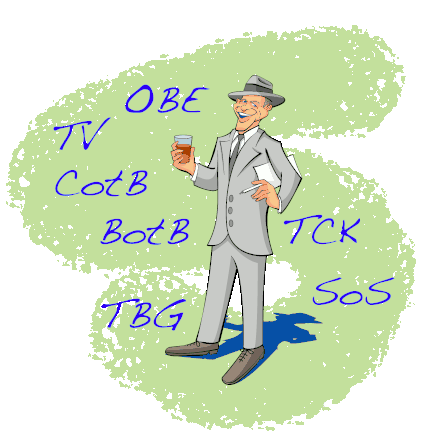
The Chairman
They couldn't give them away.
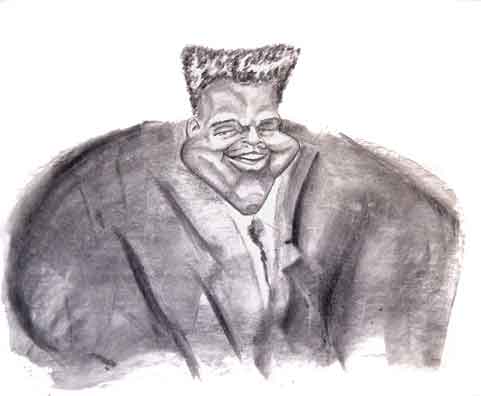
Antoine
("Fats")
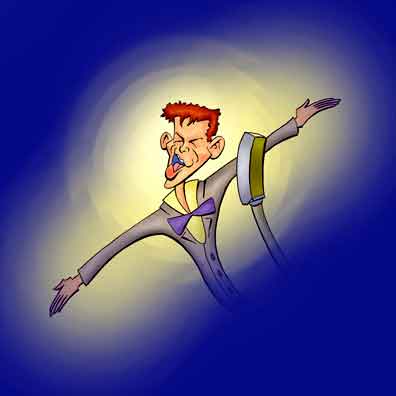
There was, though, an increasing teen population who still liked to go to sock-hops. With jazz no longer danceable other singers and musicians had to step in. But who? The teen-heart throb Frankie!!!!! who sang with Tommy Dorsey had become Frank Sinatra whose popularity quickly faded. For a while they couldn't even give his records away. Even the new teen-idols like Eddie Fisher, Johnny Ray, and Bobby Darin really appealed more to the grown-ups.
Country and Western
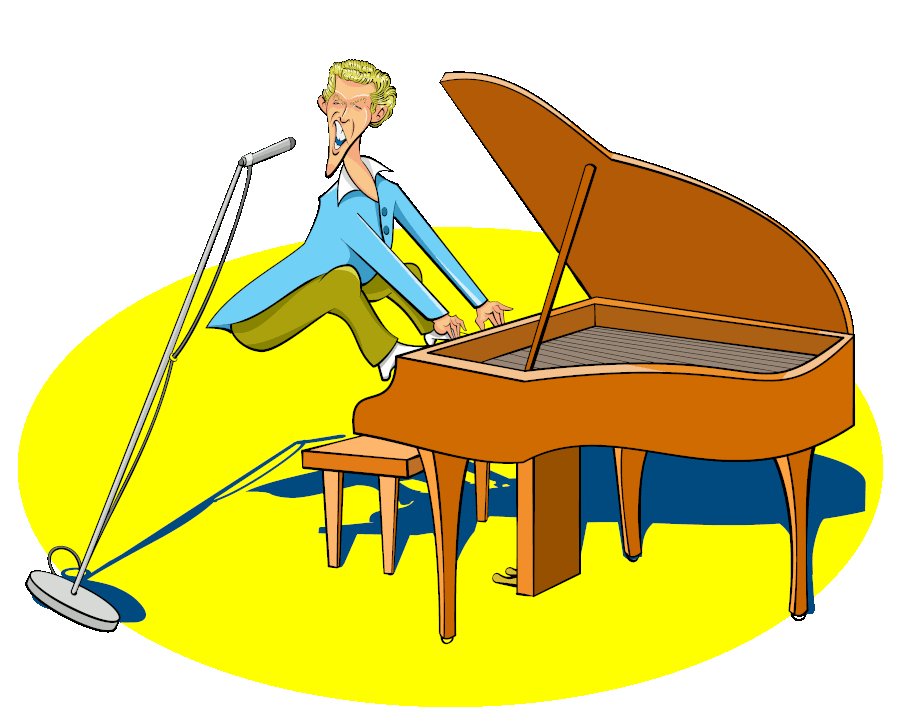
Jerry L. L.
(Click to zoom in and out.)
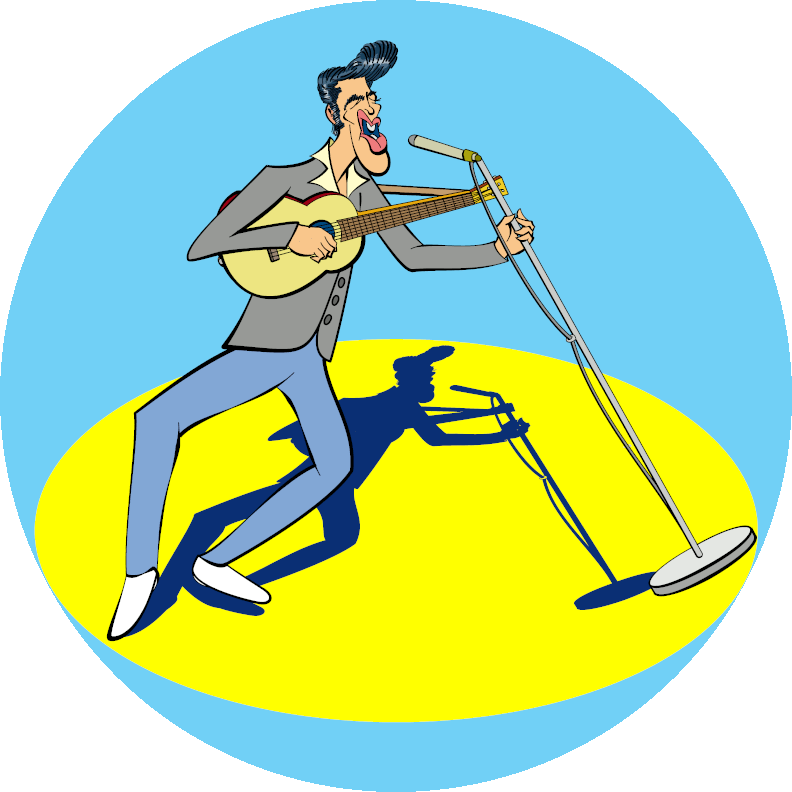
Someone Named Elvis
(Click to zoom in and out.)
But the new music was there. In addition to jazz splitting off from Swing into Be-Bop, another path led to what was being dubbed Rhythm and Blues. These new R&B groups had maybe four to five members. Some retained a single saxophone, but mostly there were a couple of guitars, a bass player, and a drummer. Some R&B singers, though, stuck with the ivories like Antoine Caliste Domino and the bands began bringing in the youngsters who ten years before would have been jazz fans.
Then a most inexplicable phenomenon occurred. Ads began popping up like:
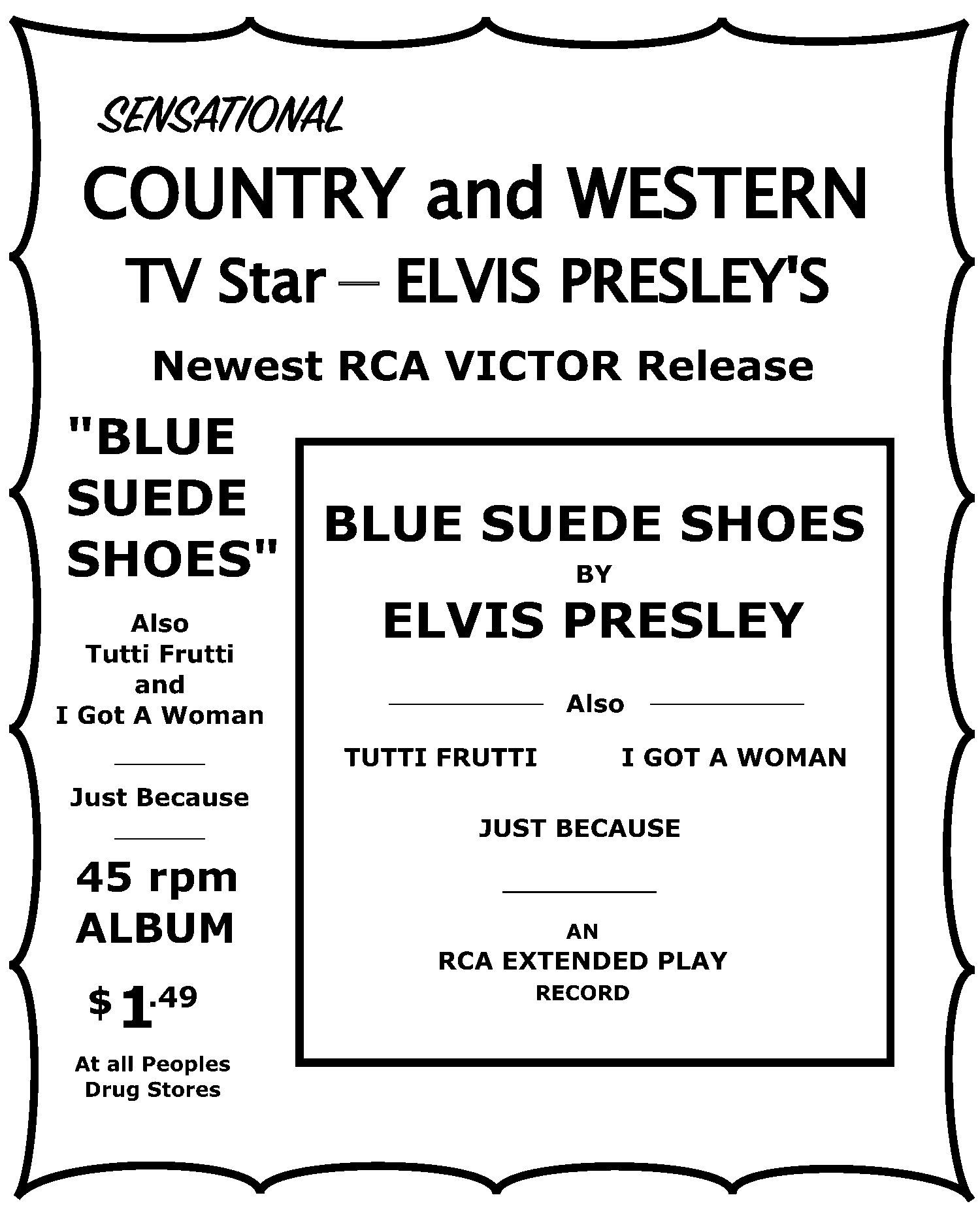
... along with notices like:
This Week's C&W Best Buys
WHOLE LOT OF SHAKIN' GOING ON (Maryln, BMI) - Jerry Lee Lewis - Sun 267 - The platter by Lewis is taking off like wildfire. Tho in release only a short while, all areas list it as a top seller. It should go well in pop and r.&b. markets, as well. Flip is "It'll Be Mine" (Knox, BMI). A previous Billboard "Spotlight" pick.
Ha? "Tutti Frutti"? "Blue Suede Shoes"? "Whole Lot of Shakin' Going On"?
COUNTRY AND WESTERN
?????!!!!!?????
Yep. And it didn't take long for these new tunes to be lumped with Rhythm and Blues into the new category called:
ROCK AND ROLL
Which was, as everyone knows, here to stay.
And Paul?
Never fear. Paul managed the tumultuous years in fine form. He continued leading his band and playing concerts and appearing on radio and television. He commissioned his long-time arranger Ferde Grofé to compose The Grand Canyon Suite which became another American orchestral classic. Of course Paul also served as guest conductor for major symphony orchestras. As one critic wrote in 1967:
In a Texas auditorium, [jazz violinist Joe] Venuti was on the same bill with Paul Whiteman, who was going to conduct a large orchestra. The presentation was typically Whitemanesque, meaning over-blown and pretentious.
By that year Paul was now 77 - a goodly age at the time and a full ten years older than the expectancy. Paul missed moving into the Incredible Year of 1968 - when men would fly around the Moon - by three days.
Although some may question if Paul really should be considered The King of Jazz, there's no doubt of his importance to American music if for nothing else for his commissioning of Rhapsody in Blue. In 1927 a gala event was held in Chicago where the music was provided by Jule Styne and his orchestra. Jule planned to play Rhapsody in Blue for the 500 guests which included 28 US Senators and 20 state governors.
At the time Jule was only twenty-two but he had already established himself as one of the top band leaders of the nation. He later would go on to write over 2000 songs and was the composer for Broadway hits and films like Gentlemen Prefer Blondes and Funny Girl.
But before the event Jule was asked by one of the organizers if he could conduct the Rhapsody. The man was a big fan of music, not just opera but of popular tunes as well, and he considered Gershwin's composition one of the greatest pieces ever written.
Normally Jule might have been reluctant to turn over the podium to someone with minimal musical training, even for a single song. But in this case he felt he couldn't say no. So the audience got the rare treat of seeing Rhapsody in Blue conducted by a guest conductor.
A guest conductor named Al Capone.
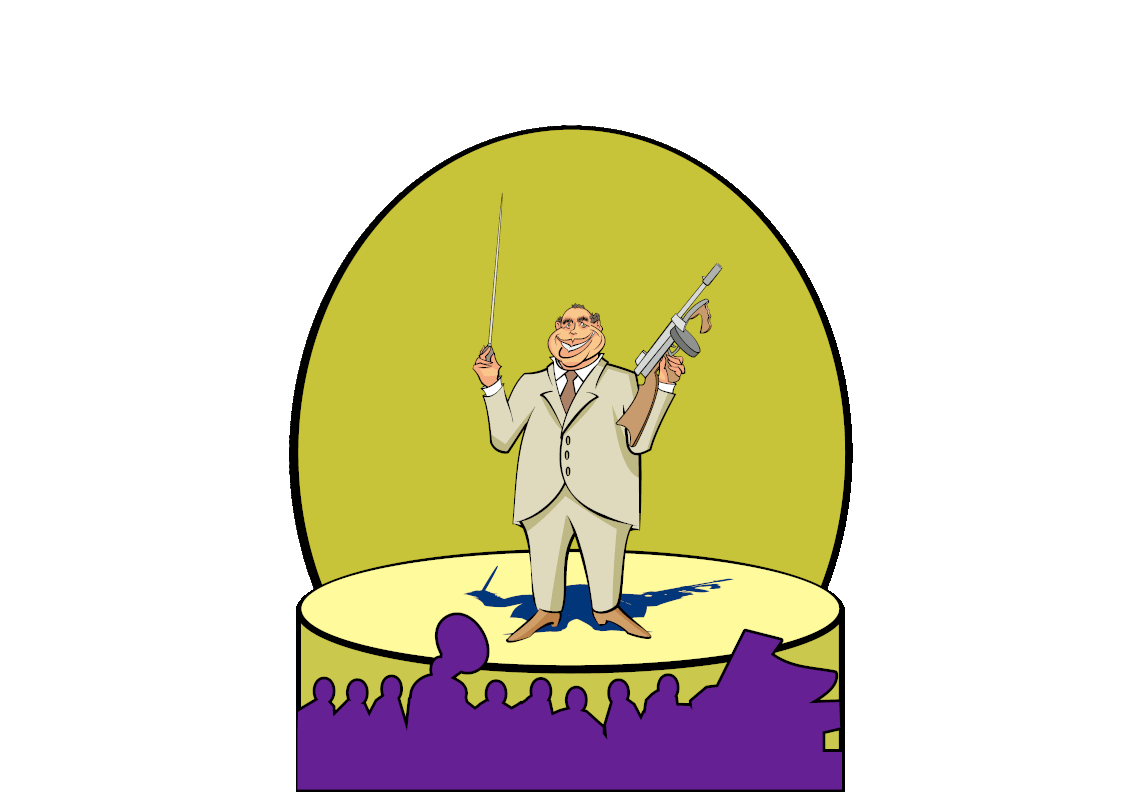
Guest Conductor
(Click to zoom in and out.)
References and Further Reading
Pops: Paul Whiteman, King of Jazz, Thomas DeLong, New Century Publisher, 1983.
"Paul Whiteman", Colorado Music Hall of Fame.
"Whiteman, Paul (Samuel)", William Ruhlman, Encyclopedia.com.
"Paul Whiteman", Discography of Historical American Recordings, University of California - Santa Barbara.
"Paul Whiteman", Steve Hawtin, The World's Music Chart.
"Foxtrot Through the Ages (1914 - Present)", Library of Dance.
"'Rhapsody in Blue' -- George Gershwin, piano; Paul Whiteman Orchestra (1924), Jim Farrington, Library of Congress.
Try and Stop Me, Bennett Cerf, Simon and Schuster, 1944.
"San Francisco, United States 1915 - Panama Pacific International Exposition", America's Best History
"Jangle of Jazz Convulses Capital", [Philadelphia] Evening Public Ledger, September 8, 1920, p. 14., Chronicling America, Library of Congress.
"The Appeal of Primitive Jazz", [Seattle] Cayton's Weekly, September 1, 1917, p. 4.
"On the Influence of Jazz", Constantin von Sternberg, [Philadelphia] Evening Public Ledger, August 31, 1920, p. 8, Chronicling America, Library of Congress.
"Philly Fifties: TV", Time.
"Jazz Musicians See Signs of Hope Despite Repeated Questions About Its Popularity", Jerry Bembrym AndScape, December 21, 2020.
"C&W Best Sellers in Stores", The Billboard, December 2, 1957, p. 58.
"Special Events: University of Miami Symphony Orchestra - Paul Whiteman, Guest Conductor", [Washington, D. C.] Evening Star, May 26, 1963, Chronicling America, Library of Congress.
"The Lees Side: Music Has Its Humor", Gene Lees, High Fidelity, January, 1967, p. 118.
"Al Capone Wielded a Mean Baton", Chicago Tribune, November 12, 1989 (Updated: August 8, 2021.)
Mr. Capone: The Real - and Complete - Story of Al Capone, Robert Schoenberg, HarperCollins, 1992
"Paul Whiteman", Find-a-Grave, Memorial ID: 1095, April 25, 1998.