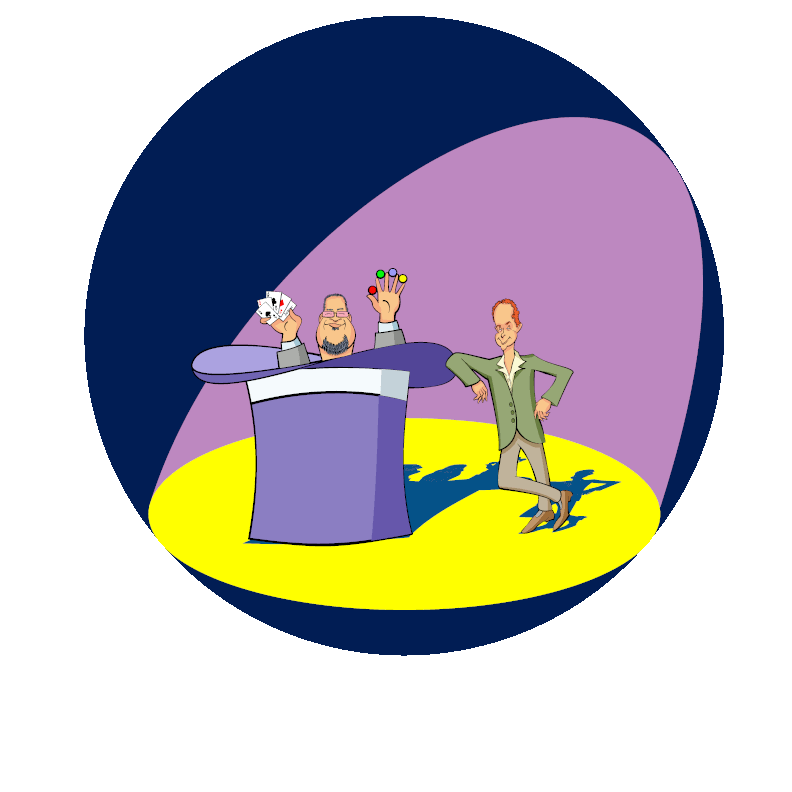
Now Presenting
Paul Daniels
and
The Lovely Debbie McGee
(And Friend)
(Click on the image to zoom in.)

I am still working on patter and presentation.
- Paul Daniels
The rise of television saw a phenomenon that seemed impossibly contradictory. No, it wasn't the sitcom where the same cast and one-room set is expected to be refreshingly humorous week after week. Sitcoms had been around since the time of Ancient Greece. Nor was it the variety show where you saw the same singers, comedians, and juggling acts year after year. No, the problematical paradox offered for your viewing pleasure was the attendant rise of the television magician. Or rather we should say the television conjuror.1
Footnote
There seems to be some inconsistency in the proper designation of prestidigitators who perform before an audience. In some early editions of a popular informational reference if the readers looked up "magician" they would be directed to the topic "conjuring". But over half a century later, if you looked up "conjuring" you'd be directed to the topic "magician".
"Magic" of course can mean the topic of purported supernatural phenomena that are instigated by saying the necessary words and preparing various concoctions while making various gestures. But it can also refer to the entertainment of conjuring. Ironically one activity of many conjurors - including Paul and Debbie - has been debunking those who claim true magical powers.
The reasons are obvious. On television or in motion pictures you can create wonders by using what was once called "trick photography". Nowadays the technique would be termed "special effects". After all, if in the movies you can see the Red Sea part, a giant ape climb onto the Empire State Building, and a giant lizard stomping over Tokyo, it should be a snap to have a magician pull a rabbit out of a hat.
So if the tricks are performed before a camera the film can be edited to make it look like the magician is doing amazing tricks. And doing on-camera magic is literally as old as cinema itself. One of the earliest motion pictures showed a train entering a station. Then a passenger comes up but trips and falls. Before he can get up, the train fades away. And yes, there is one short film that was released by Thomas Edison in 1900 where a magician makes items appear and disappear. But given the rather rudimentary technology it's obvious the tricks were achieved simply by cut-and-splice editing.
But by the early 1950's the future of entertainment was clearly with the device called the boob tube, the telly, TV, the box, vid, and the small screen - that is, television. So it seemed that with special effects now available, the truly skilled stage magicians were going to be left behind. To avoid such a lamentable fate of what was literally millennia old entertainment2, there soon emerged unspoken rules to govern the new field of Electronic Prestidigitation.
Footnote
The oldest known record of a magician performing for the entertainment of an audience was from the Westcar Papyrus written around 1650 BC. It tells the story of how a magician was summoned to perform before the Egyptian Pharaoh Cheops. Cheops - or actually King Khufu (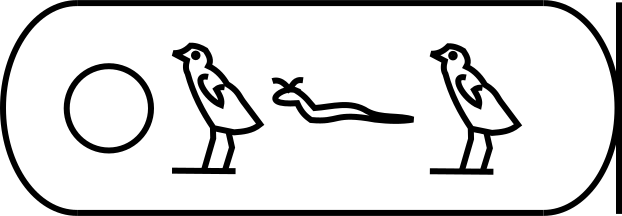 ) - was Pharaoh during the 4th Dynasty and lived around 2500 BC. The story itself, though, was fiction but it does indicate that magical performances were staged for entertainment thousands of years ago.
Specifically there was the mandate that television magicians should not use any in-camera effects which today are created by computer-generated imagery (CGI). Instead the magicians agreed that what you saw on the tube was what you would see if you were right there with a live audience.
Admittedly, television magic isn't as popular as it once was. The Golden Age of the Television Magician was arguably the last quarter of the 20th Century. It was within this span - from around 1975 to 2000 - that the British magician Paul Daniels and his assistant (and wife) the Lovely Debbie McGee appeared on the BBC.3
Footnote
If you tune into some of the shows you'll find the title card reads simply Paul Daniels or maybe Paul Daniels Magic. But in virtually all popular informational references the title is given as The Paul Daniels Magic Show.
Paul and Debbie did much of their performing in a television studio, but they also performed before live audiences. Among their repertoire were the popular sleight of hand cups-and-balls, linking rings, and coin and card tricks. But there were also the biggies made famous by the pioneers of magic and such tricks included Vanishing the Elephant.
But now with the big tricks performed regularly on television - or perhaps we should say particularly with the big tricks now performed regularly television - there's still the question whether you REALLY see what a live audience would. Of course, one way to ensure the magicians adhere to the What-You-See-Is-What-They-Do Rule is for them to perform the tricks on an actual stage and before a live audience. The cameras are then placed so they see what the audience sees and that way everything is on the up-and-up.
For instance Doug Henning was one of the most popular of the television magicians of the 1970's and 80's. He was seen by more people than any other magician in history and in one of his television specials more people saw him perform in one hour than the people who saw Harry Houdini during Houdini's entire lifetime.
And of course on one of the shows Doug made an elephant vanish. But as usual he added a new twist to the old chestnut.

Doug Henning
(Click on the image to
zoom in and out.)
Doug rode the elephant onto the stage where a cloth had been placed on the floor to show that there was no trap door that would lower the pachyderm out of sight. Then some panels were raised to form an open-topped box hiding the elephant. Doug, though, remained visible, and aided by a trapeze bar suspended from the ceiling, he was able to balance himself rather precariously on the elephant's back. Then the walls were dropped and the elephant was gone leaving Doug hanging in mid-air!
Since this was a stage trick both the live and television audience saw the same thing. So there was no "trick photography" or similar skullduggery. And during his shows, Doug stuck to THE RULE.
Alas, more recently there have been those who have been straying from the honorable criteria. Now it seems that it's OK to do a trick where a live viewer would see the performance but as limited by the perspective and range of the camera. Given that the camera view is often restricted and the peripheral angles are far from wide, tricks that work only on television are becoming more common. More lamentably camera "pans" can also be used to help accomplish seemingly impossible tricks. After all, if a camera points briefly in one direction, a lot can happen just off to the side.
Another rule that has seemingly been relaxed is the number of stooges the magician can employ. Certainly having a "confederate" (a somewhat more polite word) posing as an audience member but who actually helps with the trick is a well accepted practice. Traditionally one stooge is acceptable for the odd trick or so, and maybe two can be used in a pinch.
But the use of stooges can move beyond the bounds of good taste. For instance, it's common for the magician to have a delegation from the audience come on stage to view a trick up close. The committee may examine various apparati to show there is no obvious trickery or they may surround a closed cabinet or curtained area to show that off-stage assistance isn't possible.
But what if everyone who - quote - "volunteers" - unquote - is actually a stooge (sorry, that's "confederate")? Then while the real audience only sees the trick from one direction as well as having the view restricted by the television camera then seemingly miraculous tricks become routine.
So with this "all the world's a stooge" approach, almost anything can be made to appear or disappear by simply moving it on or off stage. The view that is blocked from the audience can easily seen by the stooges and an amazing magical performance is really something anyone could do. A most lamentable development in the World of Magic!
There's also the concern that excessive use of stooges can run up against the "Magician's Oath". That is, when a magician joins a professional organization - or even if they remain an amateur - they are bound by an affirmation that runs something like:
As a magician, I promise I will never reveal the secret of any illusion either in word or writing unless to those who are members of the organization and are also bound in secrecy to the by-laws of this organization and by this oath.
But what if you have a group of confederates and all are recruited from the audience? In that case, they all have to be in on the secret. So how can the magician "never reveal the secret of any illusion either in word or writing unless to those who are members of the organization" when a whole crowd is in on it? It does not seem possible.
Another seeming contradiction to the oath - or at least the mandate of secrecy - is that the secret of many of the Acts of Wonder and Amazement can easily be found in books available for purchase or even checked out of the local library for free. You can even buy the equipment needed with a full set of instructions. A bigger surprise is that many of the books revealing the secrets were written by the famous magicians themselves!
So it seems that there are bounds which allow magicians to reveal their tricks. But there have also been cases where people who have revealed a secret have been most severely censured.
So it seems that the Rule is that you can reveal your own tricks or write about the Old Standards. But you should never reveal a new trick of a current performer.
On the other hand it cannot be overemphasized that:
 It Is Quite Proper
For Fans of
Magic and Conjuring
MIGHT
Be Performed.
In fact that's part of the fun.
For instance when Doug made the elephant vanish he rode the elephant on stage. Remember that as the panels were raised to form the box that hid the elephant, Doug stood on the elephant's back. So it is possible that the back wall that was not visible to the audience could have been made in multiple detachable sections - a fact disguised by the walls having white vertical slats about 18 inches apart.
So the panels on the back wall could be separated and the elephant could just slip out the back. Doug would have stood on a small hidden platform on the back of the front wall which made it appear like he was still standing and balancing on the back of the elephant. When the walls were dropped the platform would then fold flat against the back of the wall and hey, presto!, no elephant!
But we did mention the type of trick that has been creeping into the magic repertory. It's not exactly using in-camera effects, but the trick does have to be recorded on video or film for it to work. The results, though, can be impressive such as when the Indian magician P. C. Sorcar vanished the Victoria Monument in Calcutta. Needless to say, the Victoria Monument is much larger than an elephant and can't move.
In the video, P. C. comes on screen where a man and a woman are sitting on the lawn taking their ease. In the background you see the monument behind a line of trees.
The couple stands up and they hand P. C. a blanket. Everyone then holds the blanket up and as the camera zooms in the monument is briefly obscured. Then after a pause, they lower the blanket, the camera pans back, and the monument has vanished!
They then raise the blanket again, the camera zooms in, they lower the blanket, and the camera pulls back - and the monument is back!
Here the clue of the modus disapperingandi may - that's MAY - be in the background. If you look at the screen when the video starts, near the left edge of the screen there is a tall tree that rises above the horizon. The shape of the tree is quite distinct and its left side looks a bit like a profile of a face with a sloping forehead, long nose, and a jutting chin.
After the monument disappears and the camera pulls back we see the assistant is standing on the right of the screen as before. But at one point he moves slightly and a tree becomes just visible to the left of his shoulder. But before the monument disappeared there was no tree of that height at that place.
More to the point if the frame is frozen and zoomed in, it can be seen that the tree has the tell-tale "face" appearance - with the characteristic sloping forehead, long nose, and jutting chin. So we see that the trees that were to the left of the monument have shifted quite a distance and now stand to the right of where the monument supposedly stood. Then when the monument reappears the tree is back on the left!
Victoria Memorial Vanish?
(Click to continue.)

The possible answer, then, is that when the blanket was raised and the camera zoomed in, P. C. and his two helpers edged over to the left and the camera panned and turned with them. They wouldn't have to actually move very far to make the monument "disappear". Then to make the monument reappear, they simply reversed the movements and the camera pulls back. Hey, prestissimo!, the monument is back!
OK. But what has this to do with Paul's disappearing elephant?
Remember we said that Paul adhered rigidly to the proper standards of television magic. That is, the tricks that he and Debbie performed are what the audience would see. However - and admittedly this is a hypothetical reconstruction - perhaps we might qualify our statement as did the Captain of the Pinafore.
Remember Doug vanished his elephant on a stage.5 But Paul and Debbie vanished their elephant in an open field. The trick was arranged on a football practice field on an army base. Paul and the elephant walked onto the field while some soldiers stood guard (Debbie was riding the elephant).
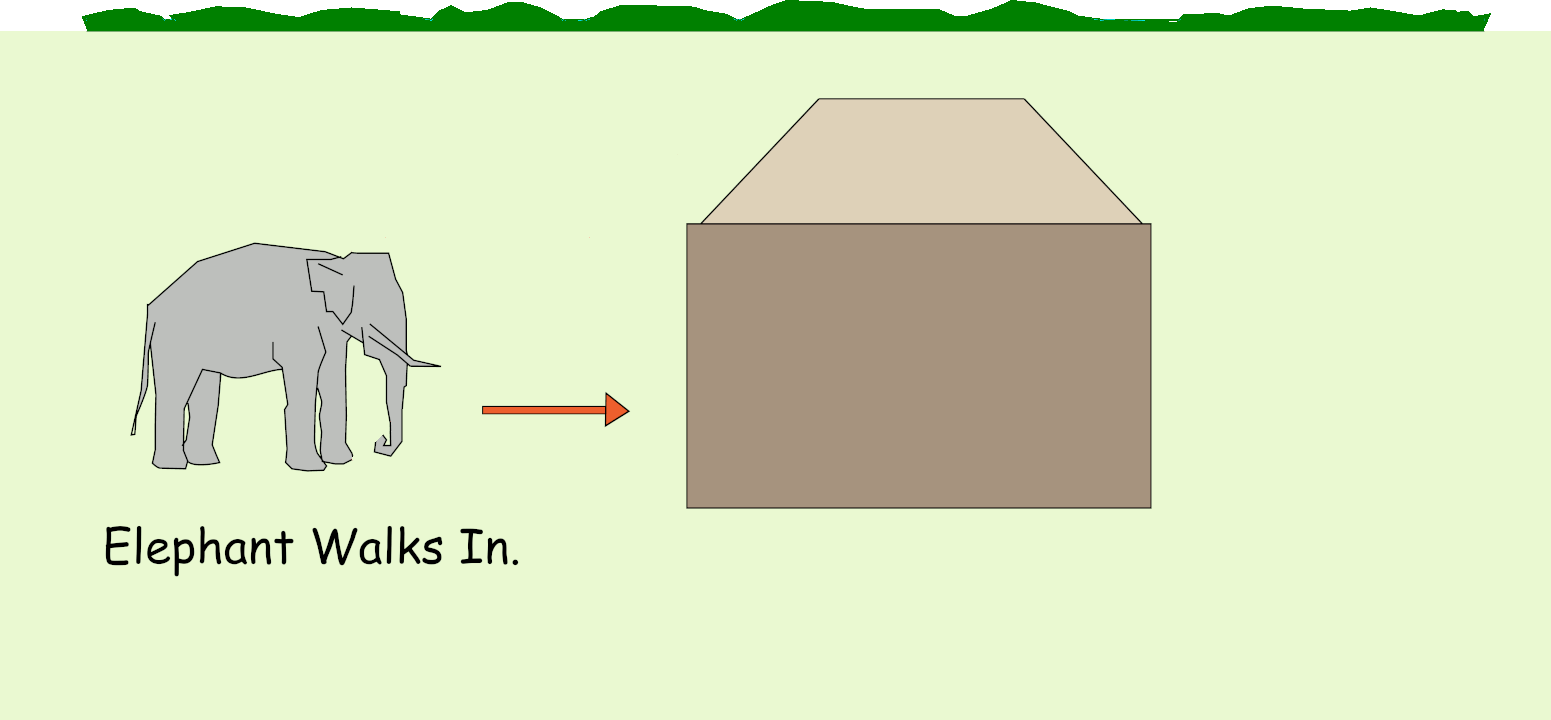
However, Paul's elephant didn't just vanish in plain view. There was a tent set up where the sides were made of canvas and held in place by metal frames. The sides could then be lowered leaving only the top of the tent in place. When the walls were down, the audience - that is the television audience - could look through the tent frame to the background and see there was no elephant. Then because of a high camera placement they could look over the top to see the rest of the playing field which ended with some trees on the horizon. Johnny Morris, the host of the British children's program Animal Magic, was present as an observer along with the soldiers.
Debbie came on the scene riding the elephant which was fairly small and was led by its trainer, Bobby Roberts. The soldiers then raised the tent walls and then Debbie, the elephant, and the trainer entered the tent from the side.
Then a small cannon was fired, the walls fell down, and hey, presto!, the elephant and trainer had vanished leaving Debbie standing inside the tent. Then to show that the elephant was really gone, the top of the tent was whisked away.
The Elephant Vanishes
(Click to continue.)
It must be emphasized that what follows is a purely hypothetical explanation much as Galileo's explanation of the heliocentric solar system was hypothetical. Robust discussion is after all the lifeblood of democracy.
A number of explanations have been advanced by the general public for this excellent trick. One is that the tent was built over a pit where the elephant was lowered. Another theory is that the back of the tent is a painted backdrop that looks like the back lawn and behind which the elephant and trainer could hide.
At this point, it should be remembered that one tenet of performing magic tricks is you never do the same trick twice - at least not for the same audience. The second time everyone knows what to look for and they may catch the deception.
But .... (And it's a big but).
Once home videos became ubiquitous, televised magical performances could be played again. Not only is this equivalent to doing the same trick twice, but the videos can be viewed many times, slowed down, and the action - as we see in P. C. Sorcar's Vanishing Victoria Monument Trick - can even be frozen.
So from a careful relook at the video of Paul and Debbie's Disappearing Elephant, it can be seen that:
First, the front and back are each made from two pieces of canvas supported on a metal frame. By dropping the frame to the ground you can see the tent's interior and out the back.
Secondly, note that when the front is lowered and then raised a middle seam is visible. But there is no separation in the two halves of the canvas. So the front wall is essentially a single canvas made by sewing two pieces together.
Thirdly, the two parts of the back canvas are NOT sewn together - at least not completely. This can be discerned at one point when the back is raised and a careful viewer can see the two halves part briefly. This difference in the construction - a single piece in front and a double piece in back - hints that the basic - quote - "vanishing" - unquote - is by having the elephant slip out the back.
Well, OK. But when the back and front drop down, there's no elephant, only Debbie McGee. And you can see out the back of the tent to the lawn. No elephant.
So where IS the elephant?
Remember the top of the tent remains in place. Then Paul jokingly tells Johnny Morris that the people may be thinking the elephant is hidden in the top. To prove this is not the case, the top is whisked away using a cable (visible if you look carefully) pulled up by a crane which is out of view. So now the viewers can see the entire background - the football field that stretches back to the tree line on the horizon.
But no elephant.
Again there is a hint on how the trick MIGHT be done. The fact that at first Paul did not remove the top - which forms a trapezoid in the viewing frame - suggests its staying in place is necessary for the trick. Otherwise it could have been whisked right away. So this raises the question that if the elephant does indeed slip out the back, could the top of the tent be big enough to literally hide an elephant?
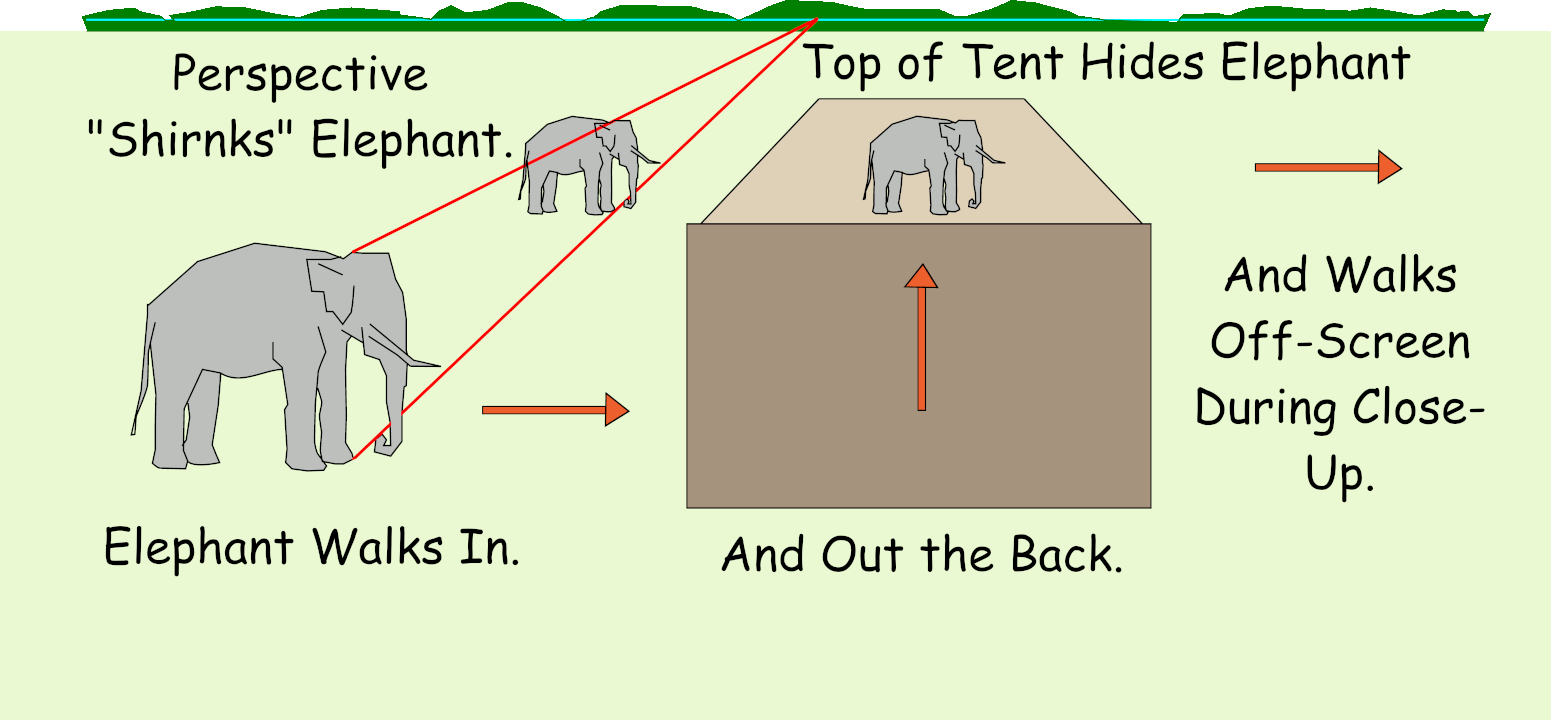
At first glance it might seem no. If you look at the trapezoidal shape, it takes up about 17% of the vertical height of the viewing frame. But the elephant - even without Debbie - takes up 25 % of the height. So you might say there is too much elephant to hide.
Weeeeehhhhheeeeelllllll, maybe not. Remember things seem to shrink as they move toward the background. And if you draw perspective lines from the elephant to the horizon you can tell how high the elephant would appear if it was in the background, say about 1/3 of the way up to the trees. A rough estimate is that would be about 20 yards from the back of the tent.
In that case the elephant's apparent size shrinks to only 7% of the vertical height of the frame - less than half of the height of the tent's top. So if the elephant slips out the back and takes her position (the elephant is named Maureen) about 60 feet behind the tent, she will easily be obscured by the top of the tent. When the tent walls drop, the camera sees no elephant.
But what about when they whisk the top away? There's no elephant. So just how did the elephant get from behind the tent and out of view?
One scholar has hypothesized that the top of the frame actually holds a mirror which hides the elephant and reflects the background. So it looks like you're seeing the uninterrupted background. Remember this technique - diagonal mirrors to make it look like an object has disappeared - is well-known to students of magic.
But the mirrors, though, reflect what's in front of them, not what's behind. So it's not quite clear how a mirror on the top of the frame in front of the viewer would reflect the background. Also if you look carefully the frame does wiggle a bit when the sides are dropped but the background grass doesn't move. If the grass was a reflection, you would expect to see some motion in the reflected image.
Mature cogitation, though, lets us realize there would really be no need for a mirror. Instead here is where television come in.
Remember, this trick was recorded on video. Then immediately after the walls drop to show only Debbie but no elephant we see
Yes, when Johnny and Paul are laughing in amazement when Paul mentions that some people may think the elephant is hidden in the top, this is a CLOSE-UP. The camera then cuts back to the long shot and only then do they whisk away the top showing there is no elephant either near or far.
The flow of one shot to another is what filmmakers call continuity. And since there is a cut to a close-up, we know the video was filmed 1) with at least a two camera set up or 2) the close-up was filmed later after the long shots were made.
Here the editor's scissors take over. In the break in continuity, the elephant and trainer simply walk out from behind the top of the tent and out of the scene. Of course, this part is cut out of the final film. So in the final film, the elephant and Debbie go into the tent, and the front and back drop down showing the elephant has disappeared. The camera then cuts to the close-up with Johnny and Paul and then back to the long shot where the top of the tent is whisked away. No elephant anywhere.
A most impressive trick - at least on camera.
How
A Most Impressive Trick MIGHT Be Done
But what about Johnny's reaction? He was clearly amazed. And Paul mentioned that Johnny had not been present at the rehearsals.
Yes, but remember Johnny was the host of the kids' show Animal Magic which ran on the BBC from 1962 to 1983. And most "presenters" on television shows - even on kids' programs - are actors who have also appeared on stage, films, and other television shows.
Indeed, Johnny's career went way back. He was in The Secret Cave in 1953 and in the BBC TV series The Pelicans and the Pirates in 1955. After Animal Magic he was in the TV movie Aladdin and the Forty Thieves. And one thing a good actor can do is laugh and look amazed. And even if Johnny wasn't at the rehearsals that doesn't mean he didn't know how the trick was done.
But... but... but... Wouldn't all this mean that the soldiers standing around supposedly to keep things on the up-and-up were also in on the trick? In other words, doesn't all this mean that everyone - that's EVERYONE - on camera were - as they are called politely - "confederates" (which sounds nicer than "stooges")?
If so, that seems rather disappointing.
Yes, indeed. But there is one tenet of magical performances. And that's the greater the trick, the more disappointing the explanation.
And all this brings us to one of Paul's most famous tricks - and one that was done in full accord with the proper standards of television magic. No tricks in camera and no surreptitious camera pans or continuity breaks.
Today there are many books and resources available to the aspiring prestidigitator. However, some of the famous tricks in the earlier books are no longer found in the modern manuals due to the hazards. For instance, the East Indian Needles Trick (made famous by Harry Houdini) and the Bullet Catching Trick are quite dangerous and should never be attempted by a student magician and in fact are largely avoided even by professionals. The dangers are by no means minor. In 1918 the magician Chung Ling Soo - who was actually an American named Billy Robinson - was killed onstage in London when the bullet catch went awry.
The Bullet Catch was and is one of the most dangerous tricks in professional magicians' repertoire. Harry Houdini was once planning to do the trick, but Harry Keller, Billy's former boss and one of the most famous magicians of the time, personally wrote Harry not to try the trick. Due to his respect for Keller, Houdini agreed to cut the trick from the act.
Bullet Catchers

Chung Ling Soo and Suee Seen
(Click to zoom in an out.)
Penn and Teller
(Click to zoom in an out.)
Despite the dangers, the trick is still performed by some expert magicians. Among the modern stagings have been by Milbourne Christopher, Dorothy Dietrich, and Penn and Teller.
And by Paul Daniels and the Lovely Debee McGee. Paul himself took the role of Chung on November 6, 1982. But what made this performance noteworthy was one of the assistants who lined up with the rifles was an elderly man named Jack Grossman. Jack, it turns out, was one of the assistants who was on stage with Chung Ling Soo on March 23, 1918. In this case with Paul presiding, the trick went off without a hitch.5
Footnote
Billy always pretended to be Chinese and when interviewed by journalist spoke through an "interpreter". Billy performed in America, Europe, and Australia, and he even went to China.
The only time he was known to have spoken on stage was when the Bullet Catch Trick failed. The gun was designed so it could be loaded with powder and a bullet but the powder charge would not ignite and the bullet would stay in the gun. A palm switch kept the signed bullet in the hands of the magician.
When the gun was fired, the smoke and noise were produced from a small powder charge in the ramrod cylinder. But in this case, the powder in the barrel ignited and the bullet fired. Billy was struck in the lung. When he fell, he cried out in English, "Oh my God. Something's happened. Lower the curtain." He died the next day.
In the investigation that followed, it was found that corrosion had created a passageway from the percussion cap to the powder charge in the breech. So the powder behind the bullet ignited sending the bullet out of the barrel.
References and Further Reading
"Daniels, Paul" The Encyclopedia of Magic and Magicians, T. A. Waters, Facts on File, 1988.
"The Paul Daniels Magic Show" The TV Data Base.