Floating and Stinging
with
Muhammad Ali
(Click on the image to zoom in and out.)
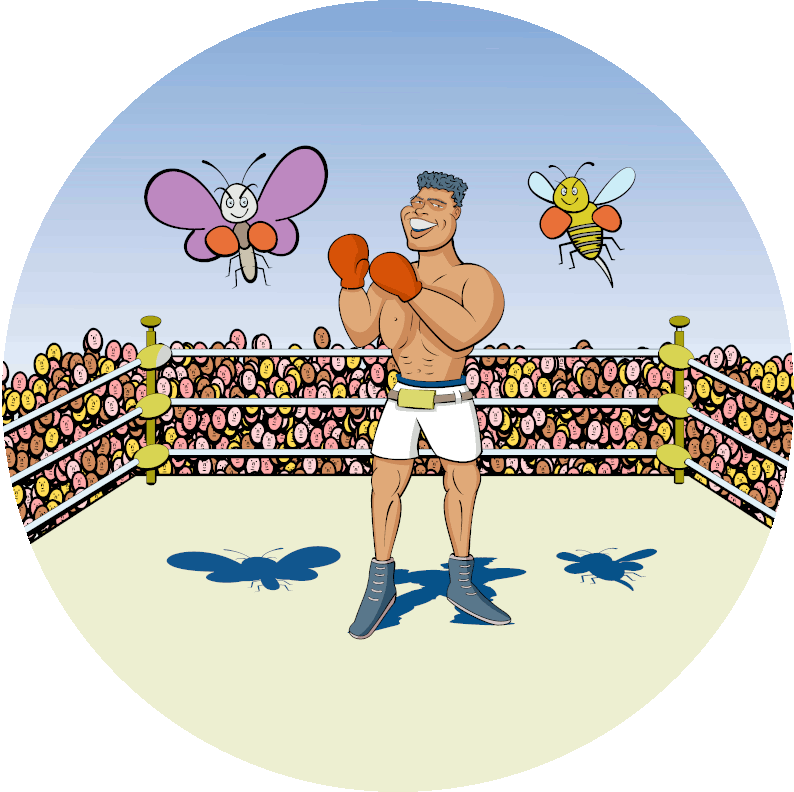
Float like a butterfly!
Sting like a bee!
The hands can't hit
What the eyes can't see!
Muhammad Ali, born as Cassius Marcellus Clay in Louisville, Kentucky, in 1947, was without doubt one of the most successful boxers in history. Even before graduating from high school he won the 175 pound Golden Glove championship in 1959 and then went on to qualify for the 1960 Olympics as light heavyweight. He won the gold medal by defeating Italy's Nino Benvenuti.
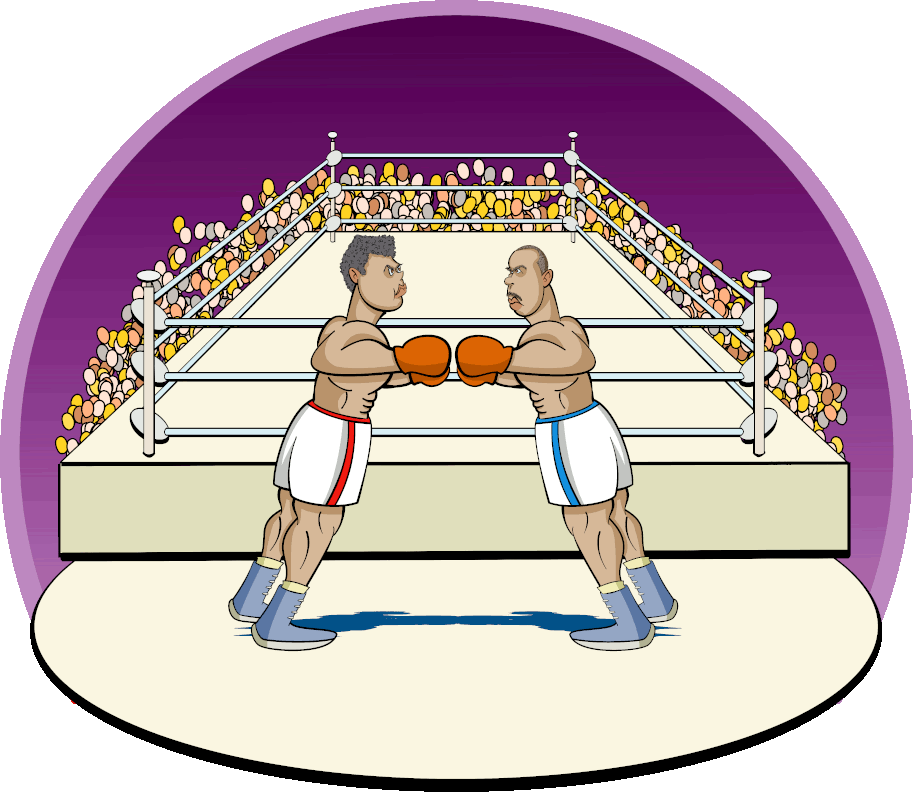
February 25, 1964
(Click to zoom in and out.)
After 76 bouts as an amateur Muhammad turned professional on October 29, 1960, when he fought - and defeated - Tunney Hunsaker in Louisville. He continued his meteoric ascent and won the World Heavyweight Title on February 25, 1964, by defeating Sonny Liston.
Muhammad continued to rule the boxing ring for the next seven years. He had (to put it mildly) superb self-confidence which delighted many and exasperated others. He remained undefeated until March 3, 1971, when he lost the heavyweight championship to Joe Frazier. However, Muhammad regained the title on October 30, 1974 by defeating George Foreman in the Rumble in the Jungle, and so regained the top spot as had Floyd Patterson when he had defeated Ingemar Johansson on June 20, 1960.
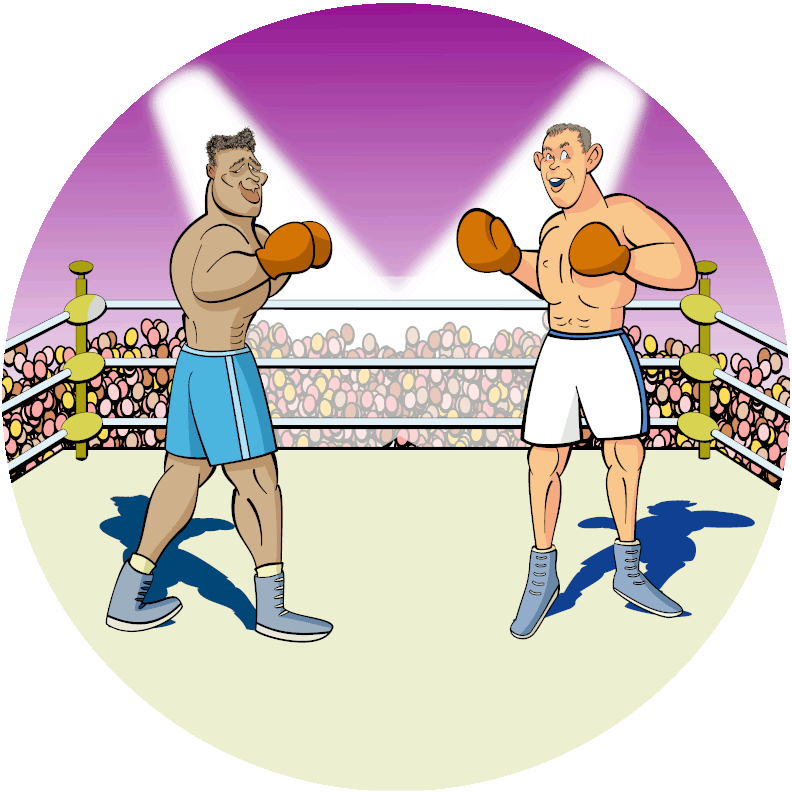
Floyd and Ingemar
(Click to zoom in and out.)
For the next four years Muhammad won all of his bouts and then on February 15, 1978, he lost to the newcomer Leon Spinks in a split decision in Las Vegas. But then in a rematch only seven months later, Muhammad defeated Leon and so became the first fighter to regain the Heavyweight Championship three times.
Out of his total of 61 fights as a professional, Muhammad lost to only five fighters: Joe Frazier (1971, unanimous decision), Ken Norton (1973, split decision), Leon Spinks (1978, split decision), Larry Holmes (1980, corner retirement), and Trevor Berbick (1981, unanimous decision). The fight with Trevor was Muhammad's last professional match.
Clearly Muhammad did not achieve such a record simply through force alone. He approached the sweet science by strategy and intelligence. So it's only proper that we conclude this essay with a discussion of the type of intelligence now in the news.
This - ah - "portrait" of Muhammad, although displayed as a digital image known as a GIF, was created from an initial pencil drawing followed by a hand rendering using scaleable vector graphics or SVG. The GIF is a bitmap "raster" where the picture is displayed by the computer defining a region of the screen and altering the individual pixels to be light or dark or of certain colors. With the right pixel tones and colors, you get a picture.
But a scaleable vector graphics displays the image as a series of equations which the computer plots on the screen. With enough and the right types of equations, you end up with pictures.
The advantage of scaleable vector graphics is when they are expanded - "zoomed-in" - the computer replots the equations. As the variable used in the equations is the pixel, the image remains sharp and does not loose resolution. The drawback is that as the images become more complex the memory needed for an SVG image goes up considerably. So it is common for the artist to use SVG software to digitalize the picture, but for display saves the image to a bitmap, whether JPEG, GIF, PNG, or now increasingly WEBP.
It is important to recognize the difference between images created digitally - even without a preliminary hand drawing - and those created by generative neural network expert computer systems often called artificial intelligence and usually abbreviated AI. Graphics programs can be used to produce hand rendered artwork as the techniques of using digital pens and bezier lines use the same skills as manipulating traditional pencils, pens, straight edges, and French curves. But it isn't true that using digital formats always saves the artist time. In fact, creating digital images is sometimes more time consuming than drawing by hand. However, making corrections and changes to digital images is sometimes (yes, sometimes) easier and faster.
Today, though, critics of less discriminating judgment are nowadays apt to dismiss any digital illustration as AI. In fact it's gotten to the point where curmudgeons will look at even the most painstakingly rendered photorealistic original hand-rendered oil paintings and dismiss them as (ptui) "artificial intelligence".
Although some people of expertise have stated that AI programs have developed a human-like consciousness, others point out that AI is simply collections of algorithms stored in computers which have no more consciousness than the electrical circuits in a house. And AI has been around literally since the beginning of the computer age. The simplest AI programs are those that suggest words when writing text. Images are created by algorithms linking descriptions of art created by humans with the images, processes which do not require any human-like consciousness.
One argument that AI does not have human cognizance is not just in the MATTER but in the MANNER when AI gets things wrong. Some AI mistakes are such extreme whoppers it's hard to believe that something with human-like consciousness could make such errors. Some of the more incredible mistakes are inventing entire sports leagues that never existed, creating images of people with seven fingers on each hand, saying the Sun rises in the west, recommending eating inedible household objects, designing objects that defy the laws of physics, scheduling business meetings at 1:00 a. m., writing movie scripts where every character has the same name and exit a scene by flying through a window, drawing maps with continents in the wrong hemisphere, citing references that don't exist, and creating a Renaissance madonna with three arms.
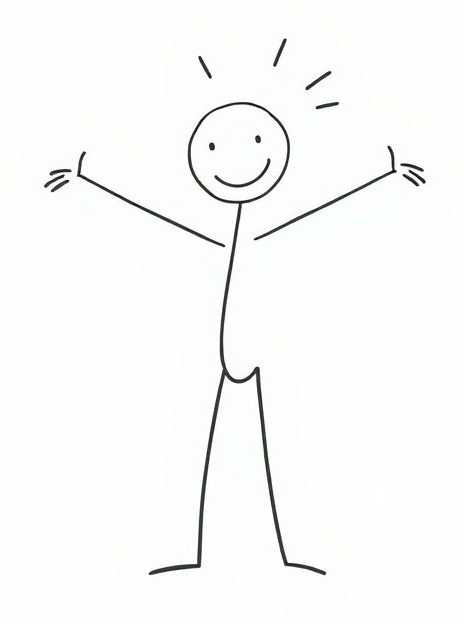
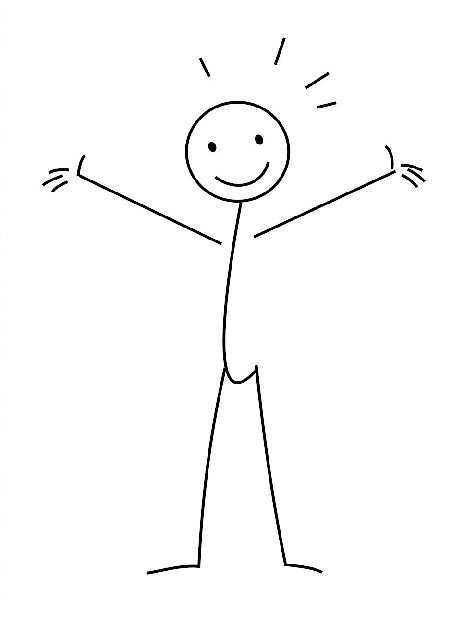
Good AI detectors will readily distinguish an AI image from a digital image created by a human. For instance in the table below, one of the figures was created totally by AI using a text prompt: "Draw a stick figure." The other drawing was then a trace of the AI stick figure but created by hand. Before clicking on the table to reveal which is which, it is a good exercise to first guess which is which.
| AI Image Detection (Click to show AI vs. Human.) | Image 1 | Image 2 |
 |  |
|
| Method: | ? | ? |
| Detector Identification: | ? | ? |
The table shows that the AI Detector correctly identifies the human creation. But as a good AI detector should, it also shows that - in this case at least - there was a hint of an AI source behind the hand rendering.
Some AI Detectors will also list detailed criteria for the finding. For instance when checking the above image of Muhammad and his friends, a popular image analyzer correctly identifies the image as 100% Human - there was no AI assistance at any point - but also tells us the reason for the classification:
AI Analysis: 100% Human (Click to zoom in and out.) |
|
| Face and Expression: | The boxer features a classic, hand-drawn cartoon with exaggerated proportions typical of traditional 2D comic art. The facial features, teeth, and eyes are drawn with clean outlines and solid color fills rather than the gradient shading and blending errors typical of generative AI models. There are no signs of AI facial hallucination or unnatural blending artifacts. |
| Hair Detail | The hair is rendered in a stylized, blocky, wave-like pattern common in vintage cartoon illustrations. The lines are deliberate, uniform in weight, and show the intentional artistic choice of a human illustrator rather than the chaotic, feather-like strands often produced by AI image generators. |
| Clothing Texture | The shorts, belt, and boxing gloves display clean, flat comic-style shading with simple highlights and shadows. The belt buckle and glove textures lack the complex fabric texturing or chaotic artifact patterns commonly associated with AI synthesis. |
| Background and Lighting | The background consists of a circular framed drawing filled with a crowd of repetitive, simplified spectator heads, classic cartoon insects, and a boxing ring with ropes. The composition, perspective grid, and line art show consistent artistic style throughout, without the geometric distortions or vanishing point errors frequently found in AI architectural drawings. |
| Fine Details | The entire image is executed in a consistent cartoon art style with black outlines, flat colors, and a visible dotted grid overlay pattern. There are no corrupted text elements, unusual digital artifact smudges, or hybrid photo-cartoon blend errors. |
| Hands and Body | The hands are enclosed in standard large, stylized cartoon boxing gloves with clear stitching details, avoiding the common multi-finger errors of AI hands. The muscular anatomy is intentionally exaggerated in a classic caricature style. |
| Overall Assessment | This image is a clean, traditional 2D cartoon illustration depicting a boxer in a ring with a crowd and cartoon insects. All stylistic elements, clean line work, flat shading, and composition point strongly toward an illustration created by a human artist rather than artificial intelligence. |
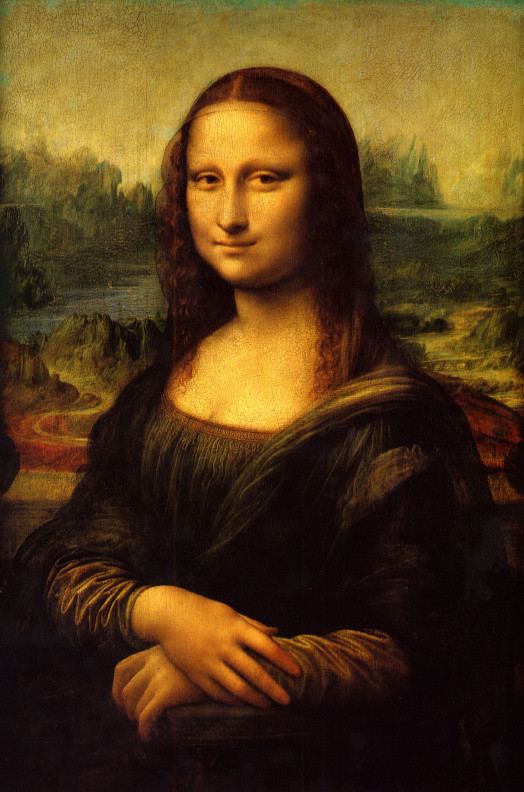
But it can't be over-emphasized that before an AI detector is used, its performance must be validated. That is, you take items which are AI generated and items that are human creations and verify the detector can correctly tell them apart. For the detector used above - which we'll call Detector #1 - we see an additional test shows that the analysis is correct.
| AI Detector | Image 1 | Image 2 |
|  |
|
| Detector #1 | 100% Human | 100% Human |
But be warned! Remember the AI Detectors are themselves created by AI. So Artificial Imbecility can set in. And in the same test using another AI Image Detector that we will call Detector #2 (and out of courtesy will not name) you end up with:
| AI Detector | Image 1 | Image 2 |
| |
|
| Detector #1 | 100% Human | 100% Human |
| Detector #2 | 95% AI | 94% AI |
But in any case and whatever the test, the two works are obviously of equal artistic merit.
References
Muhammad Ali: The Greatest, Susan Brophy Down, Crabtree Groundbreaker Biographies, 2013.
The Mammoth Book of Muhammad Ali, David West, Robinson, Running Press, 2012.
Ali - The Greatest: Trivia, Facts and Quotes, New Holland Publishers Staff, New Holland Publishers, 2016.
Ali's Knockout Punch: How a Photograph Stunned the Boxing World, Michael Burgan, 2017.
"25 Funniest AI Fails That Will Make You Laugh Out Loud", AI Tech Trend, April 10, 2026.