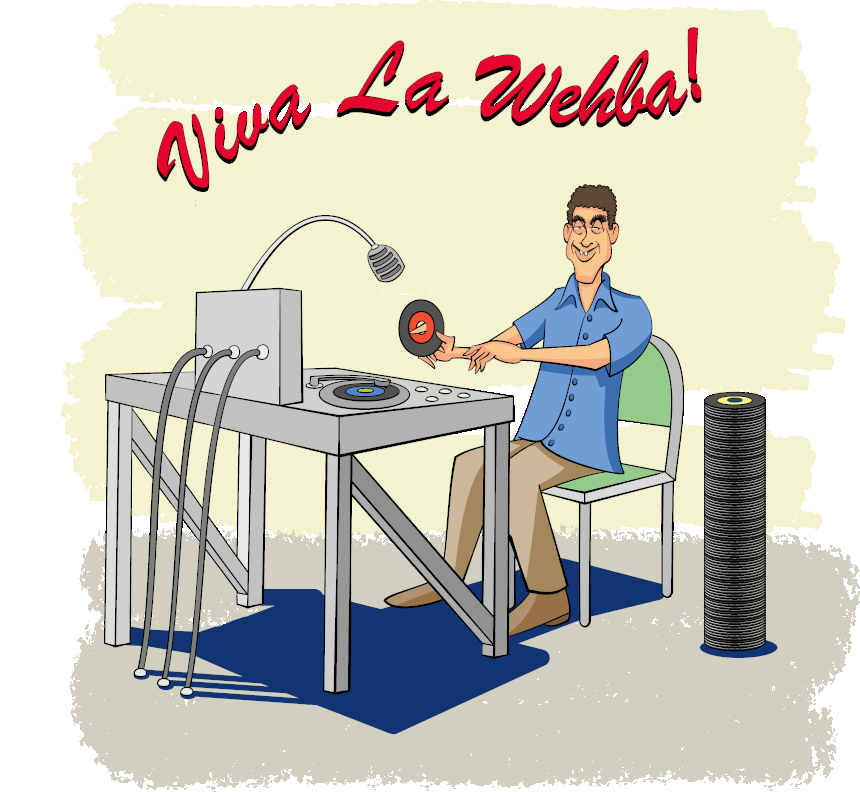
Voici le disc-jockey extraordinaire
Dale Wehba!
(Click to zoom in and out.)
"It's Viva La Wehba with the hip-high stack of shellacs!" - Radio Broadcast, 1965.
Yes, believe it or not, the French Academy actually accepts le disc jockey as the proper mots français for disc jockey. You'd expect it to be something like le personne qui pose des disques sur une platine et les diffuse lors d'une émission de radio.1
Footnote
In the 1970's the Académie Française began cracking down on the English borrowings (loanwords) they considered unsuitable for proper French. The winnowing still continues today. For instance, the Académie recently demanded no more les e-sports. Instead you should say les jeux video de competition and le streamer must be le joueur-animateur en direct.
However, some franglais is practiced without much censure. One common English borrowing is le week-end which when spelled with a hyphen is generally acceptable. But if in doubt or in highly formal situations, the official French is la fin de semaine.
But first of all, the name Wehba is pronounced WEE-buh, not as might be thought WEH-buh.2 And a "hip-high stack of shellacs" refers to the type of disk records that were produced beginning around 1950.3 This was the plastic 7-inch diameter "single" disk played at 45 revolutions per minute (rpm) with one song per side. Usually the song that the producers thought would be the bigger hit would be labeled the A-side and the other song is (obviously) the B-side.
Footnote
The name "Wehba" is of Middle Eastern origin and is derived from the Classical Arabic verb, wahaba (وَهَبَ), meaning "to give or bestow". Although the name is often transcribed as "Wehba", if it is pronounced in Classical Arabic it would be "Wahbah" or "Wahbahtun" if the formal ending, -ahtun (ةٌ), is expressly pronounced. The name "Wahbah(tun)" is written in Arabic script as وَهْبَةٌ.
The name in America is quite rare and in the 2010 United States Census there were only 103 people listed as having the name. In the 2020 Census the name wasn't listed at all which indicates there were fewer than 100 people with the surname.
A popular informational reference work shows that in the United States the name is concentrated in the Oklahoma and Texas areas with some Wehbas hailing from California. With the caveat that the sampling was fairly small - less than 50 individuals - the geographical regions searched included all of the United States. 60% of the Wehbas were from Oklahoma, most from around Oklahoma City. 33% were from Texas and the remaining 7% were from California.
World wide the name appears most frequently in Mauritania, the West Africa country just south of Western Sahara and Morocco and with a short common border to the northeast with Algeria. Most of the west border and about 2/3 of the southern border is with Mali and the remaining 1/3 of the southern border to the Atlantic is common with Senegal. One source lists 549 Wehbas in Mauritania while there are 108 in Egypt.
For those whose Spanish is a bit rusty, "Viva!" is the subjunctive tense of the verb "vivir". The subjunctive tense - or actually the subjunctive mood - has a number of functions and these include actions that may not be true even though it might be wished that they are.
"Viva!" is itself a call or shout of approbation and is pronounced VEE-vah. Strictly speaking it means "May he (or she) live!" implying the speaker wants this to happen with the connotation the action will continue. So "Viva La Wehba!" strictly speaking means "May The Wehba Live Forever!" In ordinary English we'd probably translate this as "Hooray for Wehba!" without the definite article "la". In fact a native Hispanic speaker would likely shout "¡Viva Wehba!". But " Viva La Wehba!" sounds better.
"Viva!" really is an exhortation in conversational Spanish and isn't just something you read in old novels or hear on movies about Mexican banditos. In fact the last words that the famous Mexican politician Pancho Villa heard were "¡Viva Villa!" After the Mexican Revolution ended around 1920 - actually it sort of petered out - Pancho had been granted amnesty and a hacienda near Parral, Mexico. Since the Revolution was over he had became lax with security and on July 20, 1923, he was driving through Parral when a man shouted "¡Viva Villa!" No doubt giving a smile and nodding at the compliment, he was immediately hit with nine dum-dum bullets and he vivaed no more.
Footnote
The first 45 single was released commercially on March 31, 1949, by RCA Victor.
Starting from around 1955 and into the late 60's these 45's (as the disks were usually called) accounted for the majority of record sales in the United States. Today, though, the sales of new 45's have virtually vanished from the face of the Earth. From their peak year of 1968 sales have dropped off by nearly 95%.
Despite the reference to the "stack of shellacs", even before the 1950's records were mostly manufactured from polyvinylchloride. Colloquial usage quickly turned this to "vinyl" and to this day vinyl is the common term used to refer to the old style recordings whether 45 singles or the 331/3 rpm long play (LP) albums.
Early records, though, were indeed made of shellac. Shellac is a naturally occurring resin excreted from the female lac beetle, Kerria lacca. The resin is harvested by scraping it off the tree limbs and so the bugs themselves aren't hurt. In fact, you want to keep them alive and healthy so they can make more shellac. Nowadays shellac is often used to coat wood or other surfaces.
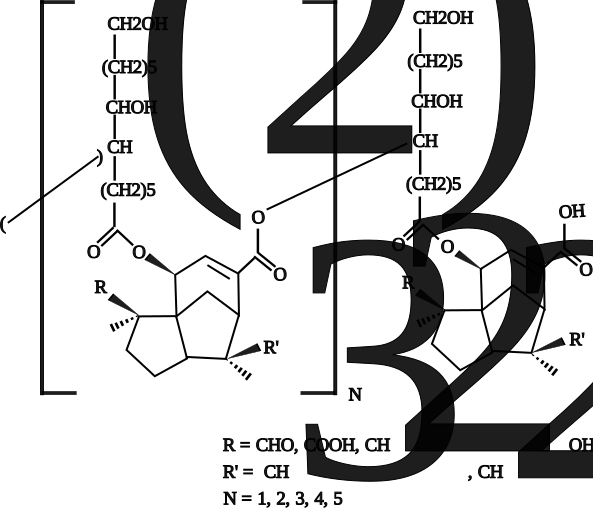
Shellac
Shellac molecules are linked together in groups of up to around six individual molecules. Such molecular conglomerates are termed oligomers as contrasted to polymers where the individual molecules are linked together in longer chains (oligomer units also tend to be larger than the polymer monomer units).4 Because shellac isn't made up of a single molecule it doesn't have a definite crystalline structure and is an "amorphous" material which tends to have low brittleness.
Footnote
Where an oligomer ends and a polymer begins is a bit fuzzy and there is no officially designated boundary defining the two molecular conglomerates. Popular informational references tend to say an oligomer has around 2 to 20 repeating units and polymers have 100 or more units. You do wonder what you call molecular assemblages with between 21 to 99 units. Oligolymers? Polyligomers?
The "shellac" used to make the older records wasn't straight out of the can. Instead, the shellac was blended with a "filler" which was often just powdered carbon. The carbon not only colored the records black but gave extra strength to the disk.
Shellac records tended to be thick - about 1/4" - and heavy, and even though amorphous and containing the filler, they could still break if dropped. The diameters varied from 7" to 16" with 10" being common. Since the sound was produced by the surface grooves vibrating a needle, the shellac records also wore down fairly quickly which produced the scratchy sound that you so often hear on audio reproductions of 1920's-era recordings. Although some shellac records were still being produced into the 1950's, vinyl began to be used commercially by the late 40's.
Vinyl records, though, are made from a true polymer which is formed by reacting vinyl chloride, the small C2H3Cl molecules, with themselves to form long chains which pack together. As is true of shellac, vinyl materials are not made up of a single molecule but are mixtures of different molecular weights.

Vinyl
Polyvinylchloride
(x ~ 1000).
The vinyl polymers, though, can still be brittle. So to add flexibility small molecules called plasticizers are mixed in. The formulations for the vinyl records are tailor made to have good rigidity but enough flexibility to resist breaking.
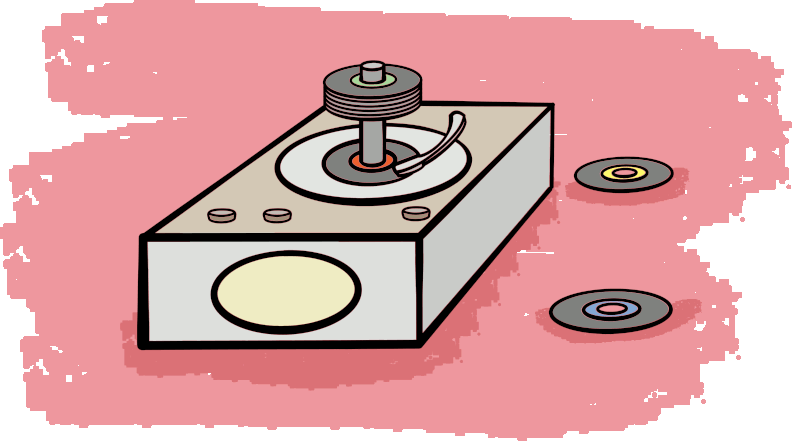
Stacking 45's
Not shellac and not hip-high.
The light weight and flexibility of the vinyl records made it possible to use phonographs - "record players" - that allowed multiple records to be stacked and automatically dropped to the turntable. So it was no longer necessary to get up every three minutes to change or flip the record. The stacking was possible for both the 45's and the 331/3 LP's but was particularly popular with the 45 rpm teen market. The picture of the ponytailed girl in pedal-pusher jeans lounging around on the floor while listening to her teen idols like Fabian became a near iconic image of the era.
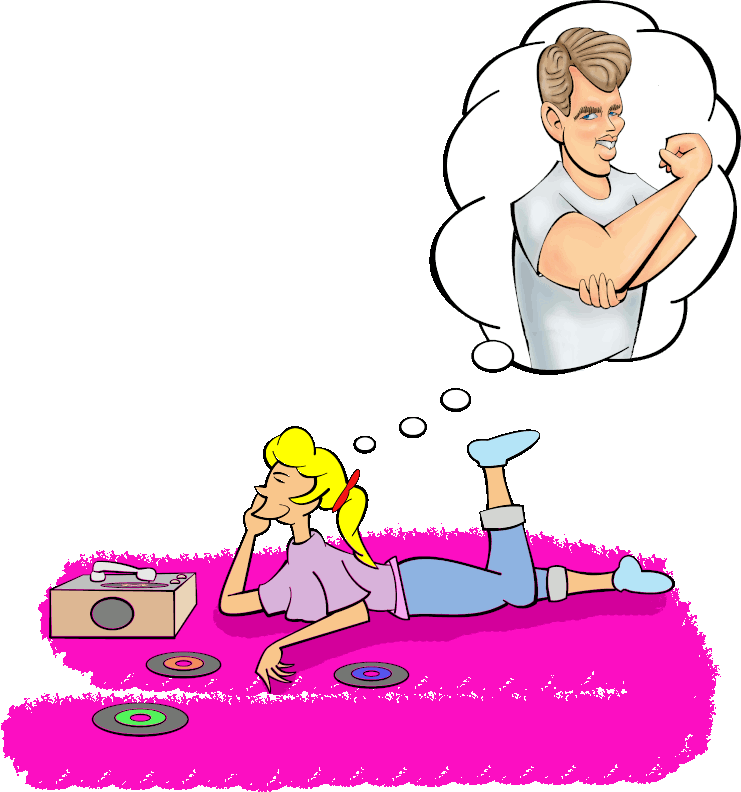
Iconic Image
So the real advantage of vinyl is the records can be thin - about 1/40" - and flexible and their surfaces last longer. But we have to admit saying you have a "hip-high stack of shellacs" sounds better than saying you have "a pile of vinyls in our bynals".
But whatever you call the records and how you make them, Dale Wehba was a pioneering promoter of the brand of music that brought the 45's to be essential for the well-being of many an American teenager. To this end in 1954 and while still a senior at Classen High School in Oklahoma City, Dale landed a job as a disc jockey at KLPR Radio. His voice was a resonant and pleasant baritone that was immediately recognizable. One of the young DJ's earliest coups was arranging an on-the-air telephone interview with a member of the US Army's 3rd Armored Division named Elvis Presley - albeit by using a bit of subterfuge to get him on the phone.
From the start Dale was dedicated to promoting the type of music called Rock and Roll. However, at that early date, the music that was being called Rock and Roll hadn't quite gelled into the music the kids grew to love and their parents couldn't stand.

Alan Freed
(Click to zoom in and out.)
As students of American Culture are aware it was Cleveland disc jockey Alan Freed who claimed to have invented the name "Rock and Roll". Although it's possible to dispute Alan's claim it's undeniable that he was an important force in bringing Rock and Roll into mainstream entertainment. Although in later years he had personal and professional difficulties, one of his most laudable accomplishments was that he insisted that his shows - on the radio and live concerts - feature the original black musicians and not just white "cover" artists and that teens of all races be allowed to attend his Rock and Roll "Moondog" Concerts.
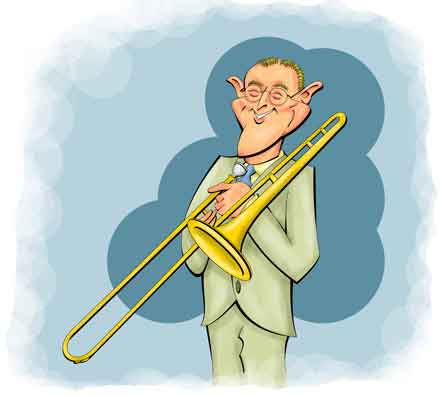
Tommy
(Click to zoom in and out.)
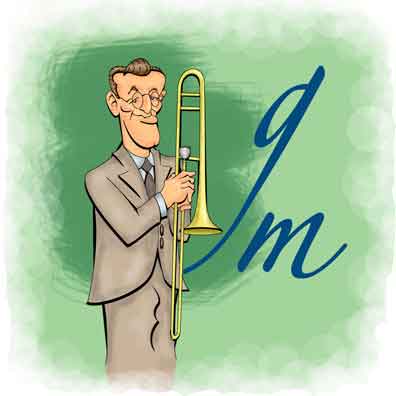
Glen
A point often omitted in the writings of scholars about popular music is that some of the early - quote - "Rock and Roll" - unquote - that Alan was advocating was the old Big Band Swing Music similar to that of played by Tommy Dorsey and Glenn Miller. In the 1956 motion picture Rock! Rock! Rock! Alan comes on screen and proclaims with exuberance:
Hello, everybody, how are you all? Welcome to our Rock and Roll [emphasis added] Jubilee of Stars! And here we go to rockin' with wailin' tenor man Freddie Mitchell and the "Rock and Roll Boogie"! Here we go!
And Alan then kicks off what is - literally - a seventeen-man swing band with full saxophone and brass sections plus drums, guitar, stand-up slap bass, and piano while Freddie solos on the tenor saxophone. Then the scene switches to a family where two teenage girls (one being a quite young Tuesday Weld) are watching the performance on the television. They are clearly enjoying the song while the pipe-smoking father grumpily reads the newspaper.
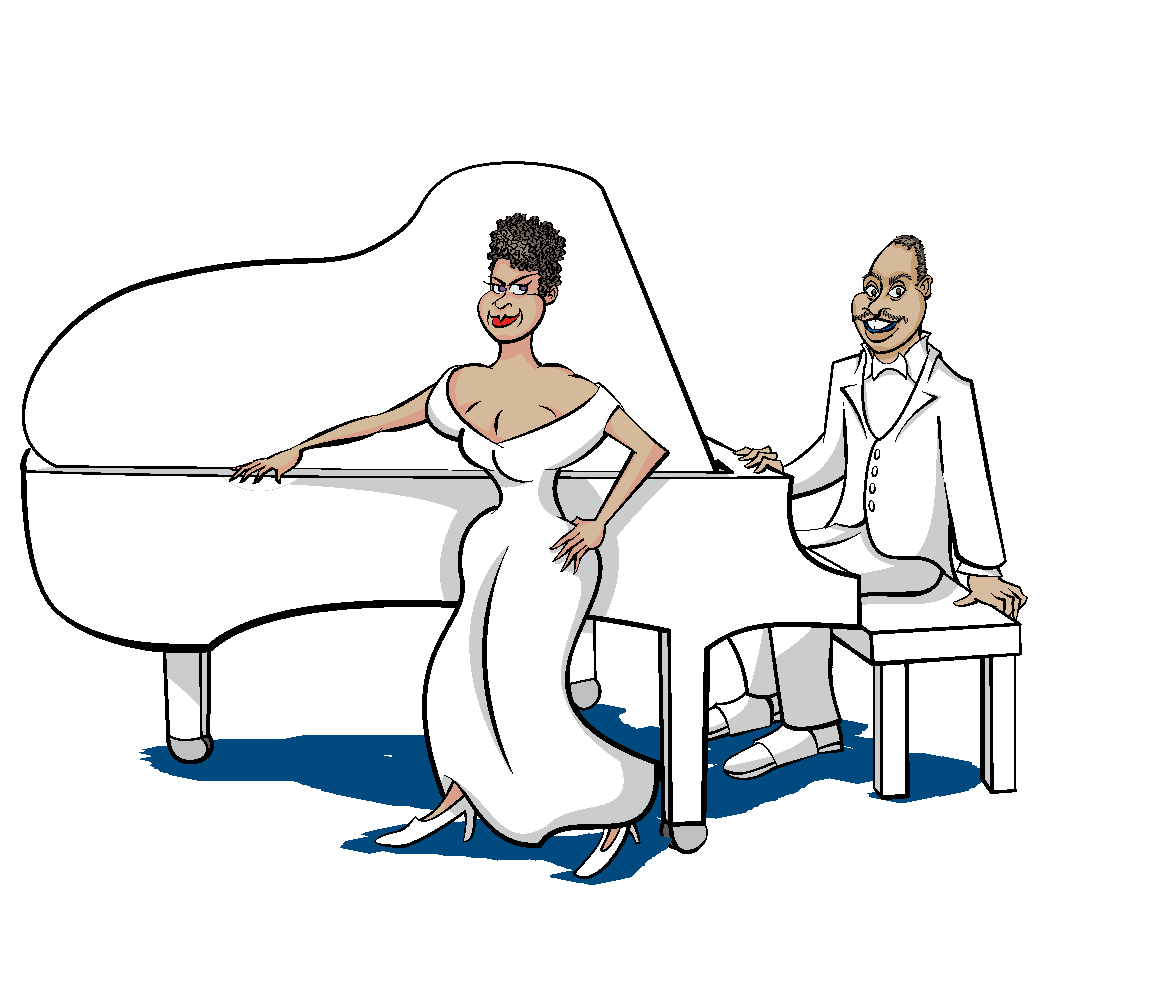
Count Basie (and Ruth)
(Click to zoom in and out.)
Then for another of Alan's - "quote" - "Rock and Roll Parties" - unquote - the house band that provided the music was led by none other than Count Basie. Yes, THE Count Basie. Count Basie was a great musician who played great music, yes, but he was Swing and Jazz, not Rock and Roll. Then in one of Alan's Rock and Roll radio broadcasts in 1956, he introduced the show with - get this - a big band rendition of "Tuxedo Junction", the Erskine Hawkins composition made famous by Glenn Miller.
Clearly what was needed was a way to move away from the Swing format. An obvious process toward this end was to pare down the size of the bands but keep the bounce. Fortunately this size reduction was already pre-prepared from an unexpected, largely neglected, and often ridiculed musical genre. That was Country and Western.
In fact, in 1954 when Dale began broadcasting - and even as late as 1956 when Alan was still lumping Rock and Roll with Swing - you could crack open magazines and newspapers and see ads and notices like ...
Sensational
Country and Western Star
TV Star - ELVIS PRESLEY
Newest RCA VICTOR Release
"Blue Suede Shoes"
Also
Tutti Frutti
I Got a Woman
Just Because
45 RPM
ALBUM
$1.49
... and ...
This Week's C&W Best Buys
WHOLE LOT OF SHAKIN' GOING ON (Maryln, BMI) - Jerry Lee Lewis - Sun 267 - The platter by Lewis is taking off like wildfire. Tho in release only a short while, all areas list it as a top seller. It should go well in pop and r.&b. markets, as well. Flip is "It'll Be Mine" (Knox, BMI). A previous Billboard "Spotlight" pick.
Country and Western

Elvis ...
(Click to zoom in and out.)
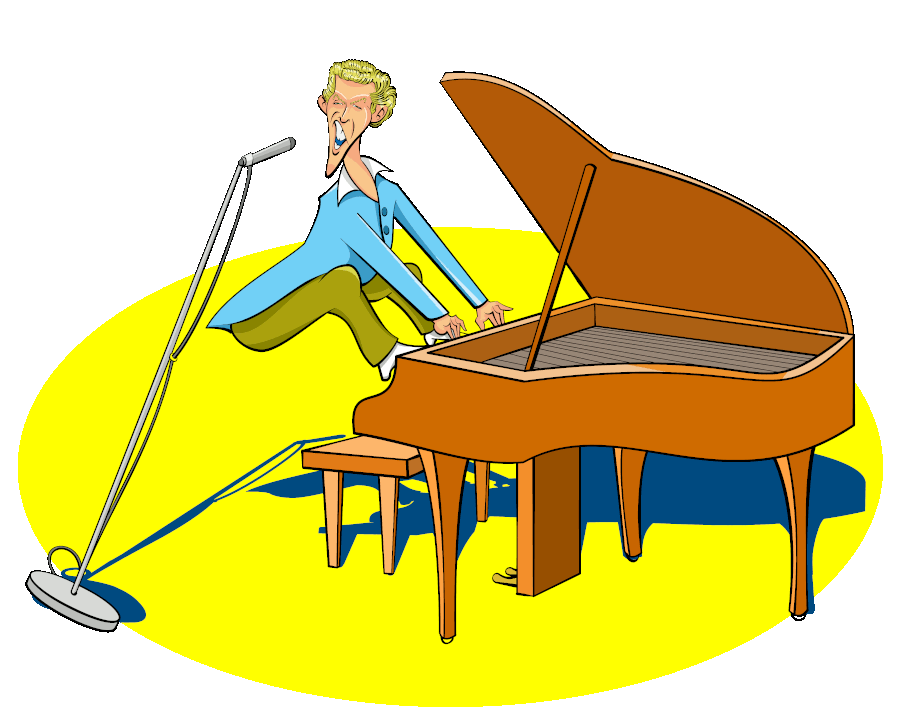
Jerry Lee
(Click to zoom in and out.)
Dale knew that labeling Elvis and Jerry Lee as Country and Western was nonsense, balderdash, and poppycock, and what Elvis and Jerry Lee were singing was a unique and important art form. Although Elvis himself never denied the C&W connection, he also pointed out that his music had deep roots from the African American musicians who had been playing what was called Rhythm and Blues.
Rhythm and Blues - R&B for short - was itself a pared down descendant of Swing Music blended with the Blues and was best exemplified by the songs of musicians like Bo Diddley, Fats Domino, and Chuck Berry. Later R&B was lumped in with Elvis's and Jerry Lee's - quote - "Country and Western" - unquote' - and it all became Rock and Roll.
Rhythm and Blues

Bo Diddley
(Click to zoom in and out.)
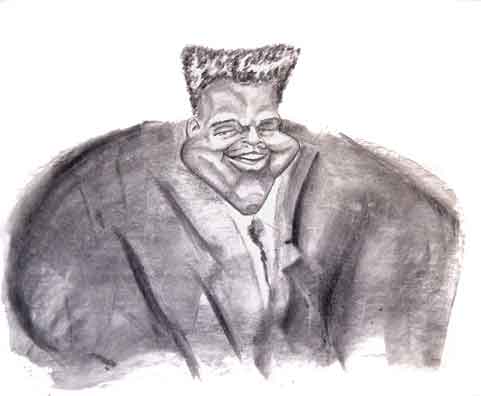
Fats Domino

Chuck
(Click to zoom in and out.)
Dale quickly began moving up the DJ hierarchy and by the time he was twenty he had moved to KOCY (now KGHM AM). Then following a spell in the early 1960's in Wichita, Kansas, Dale returned to Oklahoma City to be program director - and DJ - at AM 1520 KOMA.
Verbalized either as the individual letters KAY-OH-EM-AEE or as the acronym KOH-mah, in the 1960's KOMA was broadcasting at 50,000 watts and its waves reached from Oklahoma City to virtually all of the American mid- and far-West. Of course, the more distant listeners often had to wait until night when the nearer and smaller radio stations went off the air. So it wasn't just the kids from Oklahoma City who tuned into KOMA.
Many fans who remember the Viva La Wehba show are surprised when they realize that it aired only from 1964 to 1967. Dale then moved to Detroit to preside at CKLW and to Boston's WMEX. However, WKY - the #1 radio and television station in OKC - soon lured him back to the Sooner State.
But in terms of historical impact it was Dale's tenure at KOMA that was most notable as it occurred at the height of the Epoch That Changed the World. That was, of course, the
| Time of the |  |
 Transistor Radio Transistor Radio |
The precursor of modern mobile devices, transistor radios were inexpensive and portable battery-powered receivers. Originally they were the size of a small briefcase or purse and they could easily be carried to beach parties, hayrides, and picnics. However, in the 1950's the size of the radios began to shrink and by the 1960's they could literally be held in the palm of your hand or slipped into a pocket - all the better to conceal from those pesky authoritarian figures like teachers and school administrators.
Although many transistor radios had jacks for earplugs, it was more common for the listeners - particularly the teenagers - to simply place the speaker up against an ear as they lounged about or walked along. That way they could listen to their favorite songs and not disturb anyone. As much as the image of the teenage girl lounging on the floor and listening to her 45's, the picture of the crew-cut kid with a radio snug up against an ear helped define the era.
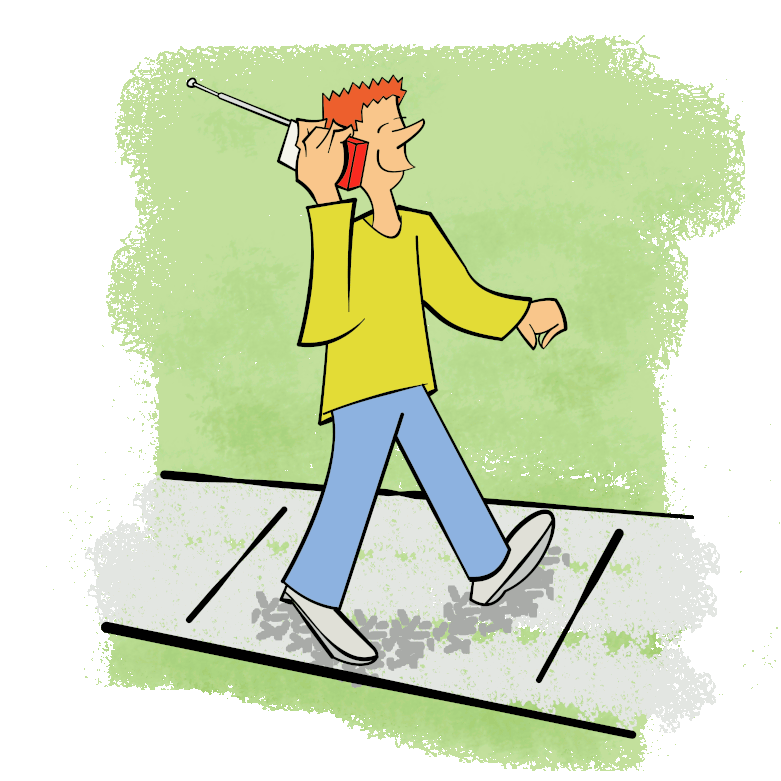
Defining an Era
In any case, with the rise of the transistor radio, music was everywhere. Music was in the parks, the backyards, and on the sidewalks. Tunes could be heard out on the porches and in the homes. You carried it with you and it moved from room to room. And to the consternation of authority, it was even in the schools. And more and more of the music that was wafting from the airwaves was Rock and Roll. And KOMA was one of the premiere Rock and Roll stations.
KOMA was first established on December 24, 1922, as KFJF Radio in Oklahoma City. That was only two years after the first US commercial radio station KDKA began broadcasting on November 2, 1920, from Pittsburgh, Pennsylvania. KOMA's broadcasting power was then a whopping 15 WATTS. Within two years the power had increased to 125 watts and in 1932, the call sign was changed to KOMA. In 1941 the frequency was upped from 1480 AM to the famous 1520. Then in 1947, the power was boosted to the maximum permitted 50,000 watts.5 And everyone remembers the phonomemorable air check,
Footnote
The 50,000 watts was the maximum permitted in the United States. Mexico had no such restriction and for years there were the Mexican "border blaster" stations, particularly XER and XERA, both being just across the Rio Grande from Texas. Boasting an effective northward broadcasting power of 1,000,000 watts the border blasters could reach a good chunk of the American public.
By broadcasting from a foreign country, the stations avoided the Federal Communications Commission (FCC) wattage restrictions and to a large extent the regulations against sponsors making outrageous claims. Nevertheless, many American stars performed on the border blasters including Mother Maybelle Carter and her daughters as well as C&W maestro Hank Williams. There were other border stations such as XELO just across the border from San Diego where a family of musicians performed - a family which included a young man from Pampa, Texas, named Woody Guthrie.
Eventually due to complaints from the FCC the Mexican government closed down XER and XERA after 1940. But other border stations continued to operate at lower wattage. This included XERB (now XERPS) in Tijuana which hosted a show by Robert Weston Smith whose nom-de-présentateur was Wolfman Jack.
KOMA Air Check
(Karaoke)
The term AM refers to amplitude modulation. This is a radio signal where different sounds are transmitted by changes in the amplitude - the intensity or "height" - of the radio waves. The other type of radio transmission is frequency modulation or FM where changes in sound are from differences in the wavelength.

Amplitude Modulation
AM

Frequency Modulation
FM
The advantage of AM is that it has a larger broadcast range than FM although FM transmissions have a higher fidelity of sound.6 So Rock and Roll stations tended to be AM so they could reach the larger audience while FM was used to reach the smaller audiences of (ugh) classical music or (double ugh) easy listening.
Footnote
Because AM alters the amplitude of the waves, some parts of the transmission have lower intensity than others even though the actual recorded volumes might be the same. Such changes in wave amplitude can affect the quality of the sound. But with the constant amplitude of FM transmissions the sound fidelity is better.
In 1945, KOMA began covering sports of both Oklahoma Agricultural and Mechanical College (which later changed its name to Oklahoma State University) as well as the sports of that august institution the University of Oklahoma. OU was soon to get a leg up in college sports as two years later they were able to hire a coach named Charles - some called him "Bud" - who was to become one of the most successful football coaches of all time. KOMA Sports also got a boost when they were able to hire a promising young announcer named Curt Gowdy who like Bud also did quite well in his later career.
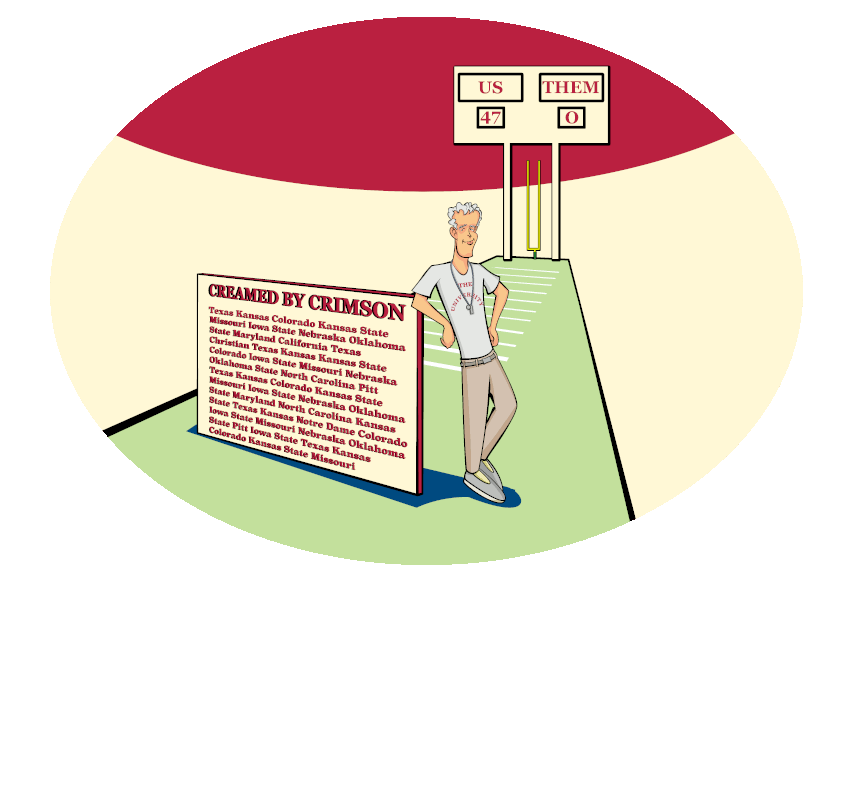
Charles
Successful
(Some called him "Bud".)
(Click to zoom in and out.)
What wasn't known to many fans of KOMA's Golden Era of the Swinging Sixties was that in 1961, the station had become totally automated. Yes, that was possible even back then. However, such a modus radioprogramibus didn't bring in the fans and at the beginning of 1964, live programming returned. It's worth noting that the timing coincided with Dale becoming the program director AND the DJ of the Viva La Wehba Show - both jobs with Dale bringing in his hip-high stack of shellacs.
Of course Dale wasn't the only DJ at KOMA and others had popularity at par. Among Dale's colleagues were Johnny Dark, Don McGregor, Phil Robbins, Charles Hanks, Joe Salvadore, William Engles, Fred More, Thom Dwyer, John David, Paul Miller, J. Michael Wilson, Chuck Dann, Buddy Scott, and the male-female DJ duo Bobby Davis and Kay. One of the most popular KOMA DJ's was Charlie Tuna. Charlie was of course a nom-de-radio and masked the identity of Chuck Riley and later of Arthur W. Ferguson.
The KOMA DJ's did not exist to the public simply as disembodied voices in the ether. They went out into the community and met the fans. One of the most popular activities was to appear in basketball games against local school teams (using made made up of the schools' coaches). These games were sure to fill up the gymnasiums.
There were also KOMA sponsored novelty activities. For instance, one of the DJ's might announce that on a particular day the "KOMA Kilroy" would be at a local junior high or high school. The KOMA Kilroy was a pre-selected student who would have a $50 voucher provided from the station. If he could keep his identity a secret for the day, he could keep the $50. But if another student asked him "Are you the KOMA Kilroy?" he had to admit it and hand over the voucher. So there were times where the only conversation among the students was "Are you the KOMA Kilroy?"

The Fab Four
(Click to zoom in and out.)
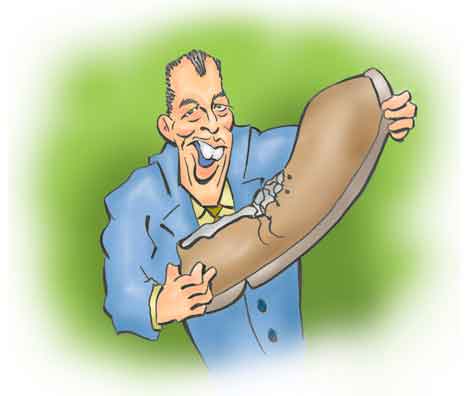
Ed
A Really Big Shew
Dale's start at KOMA coincided with the arrival in New York of a mop-headed quartet of former Rockers turned Mods from Liverpool. Sometimes called the Fab Four, the Mop Tops, and other modish monickers they had come to America to appear on Ed Sullivan's really big shew on the telly. Perhaps not coincidentally it was the following year that brought DJ John Ravencroft across the ocean to KOMA.
John was indeed an Englishman and added something of an exotic air to the station. English accents were a rarity in Oklahoma and once a woman wrote a letter saying she liked KOMA's programs and then added that she thought their - quote - "English DJ" - unquote - did a pretty good imitation of an English accent. John, who was proud of his Albion heritage, drove to the address, knocked on the door, introduced himself, and after showing the lady his passport, turned around and left.
With Dale serving not just as DJ but also as programming director, KOMA rose to be in the top echelons of AM radio stations in North America that specialized in the Top 40 Tunes. Well holding its own even with legendary WLS in Chicago and with the songs of The Beatles, The Rolling Stones, The Dave Clark Five, The Beach Boys, Dusty Springfield, Petula Clark, Simon and Garfunkel, The Doors, and the Supremes airing regularly, it was clear that Rock and Roll was here to stay.

A Future Nobel Prize Winner
The times were a-changing.
But not at KOMA. The times, as a future Nobel Prize Winner was to write, were a-changing. Dale left the station in 1967 just as a new technology began giving radio its first real competition. No, it wasn't television.7 Instead it was the arrival of portable devices for playing music of your choice.
The first of these portable platforms was for playing tape recordings wound onto self-contained cassettes. The cassettes were so small that several could be carried in one hand and yet an entire long playing album - even double albums - could be contained on a single cassette.
Footnote
Contrary to popular opinion, television was not a serious competitor for radio stations. In fact, the broadcasting networks kept the radio stations running as near equal departments with television. A contributing cause of radio's continuing popularity was because beginning in the 1950's, America was a nation on the move. Automobiles proliferated and radios became standard equipment. The increased travel in cars and trucks kept radio as a top entertainment venue. Even though Mom and Dad might not have been staying home at night and listening to The Jack Benny Show or Burns and Allen, their kids were out in their cars, driving along Main Street while Listening to KOMA and the Top 40.
Soon everyone was tuning into their favorite programs even if driving just short distances. The number of radio stations kept rising even into the first decade of the Millennium. It was only after the year 2010 that the number of commercial AM and FM stations flattened out and have since shown a decrease.
Today, though, radio is rapidly BECOMING television, particularly with regard to sports. On the TV channels - inevitably requiring a subscription - you can have the pleasure - or rather the experience - of watching radio DJ's with headphones clamped to their heads sitting before their microphones reporting the latest Sports News. Sometimes you even get to see multiple radio personalities discussing the sport events of the day - if "discussing" can be used to described five people sitting around a table and all shouting at the same time.
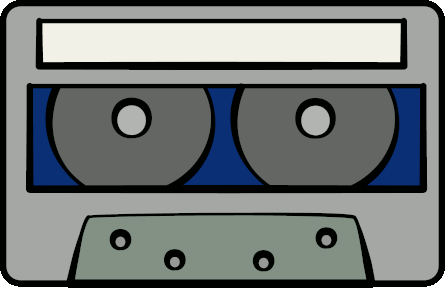
Tape Cassette
Radio Replacement
With the cassettes and portable players both available and affordable, instead of waiting sometimes hours to hear your favorite song, you could carry a library of your personal albums and listen to your favorites on demand. Radio began to lose its listeners and soon cassette players became standard features on automobile dashboards. Although the 8-track tapes - the famous "tape decks" - had a time of popularity, their relative bulkiness ensured their eventual disappearance.
By the 1980's cassette players had become as small as the hand held transistor radios and could be worn on the belt while walking and even jogging. Continued miniaturization soon made it possible to combine the radios and cassette players for your particular pleasure. The dedicated transistor radios soon vanished from the hands of the teenagers to wind up in closets, cupboards, and trash cans. Then with the rise of the CD and DVD, even the cassettes had had their day.8
So KOMA sought out a new and rising audience of a different musical genre - a genre that some felt soon began to control the national economy. This was brought home to a young man who had lived in Oklahoma City in the mid-1960's but had since moved out of state. Then in 1981 the exigencies of life brought him driving through Oklahoma and as he reached mid-state he felt a pang of nostalgia for the auld KOMA syne. Dialing to the never forgotten 1520 AM signal, he settled back and waited to be drawn back to the spirit if not the letter of the Viva La Wehba Show.
Then he heard:
This is KOMA, your COUNTRY station!
Yes, whether it was a stroke of genius or one of the worst business decisions ever, Yours Truly, KOMA, had gone Country.
Gaff or genius, Country KOMA lasted only five years and then the station returned to playing classic Rock and Roll. Of course, these were now the Golden Oldies and were no longer part of the teen market. The times had a-changed indeed.
As the 80's rolled on, KOMA became a part of the Merger Mania That Gripped the World9 and ended up being bought, sold, divested, and acquired in bewildering successions. With increasing improvements in broadcasting technology FM stations had extended their range and in 1992, KOMA management bowed to the inevitable and established a simultaneous broadcast as KOMA-FM at 92.5. Evidently such redundancy wasn't profitable enough for the stockholders' pleasure and the year 2003 brought the End of the Era.10 KOMA 1520 AM became an all-news and talk station - the bane of all teenagers - and changed its call signal to KOKC.
Technology continued to evolve and it soon became unnecessary for broadcasts to be heard from massive towers sending out electromagnetic radiation with wavelengths between 1 and 1000 meters. Radio shows could now be heard on devices that were even smaller than the transistor radios - and KOKC, the former KOMA, can be still heard as a live-streaming station as can KOMA FM Classic Rock.
And Dale?
Well, Dale Wehba kept going. He established his own entertainment company for functions and organizations that needed a first-class DJ. He even released a few songs himself. Then on January 7, 2015, at the Trolley Stop Record Shop in Oklahoma City he hosted a celebration for Elvis's 80th birthday. Among the notable activities of the day was when Dale interviewed one of Elvis's former sergeants from the Army. Dale kept spinning the platters - that is, his hip-high stack of shellacs - until January 17, 2025.
For years a neon sign had hung in the old KOMA studios and blazoned: