Alexandre Dumas, Pere
(Click to zoom in and out.)
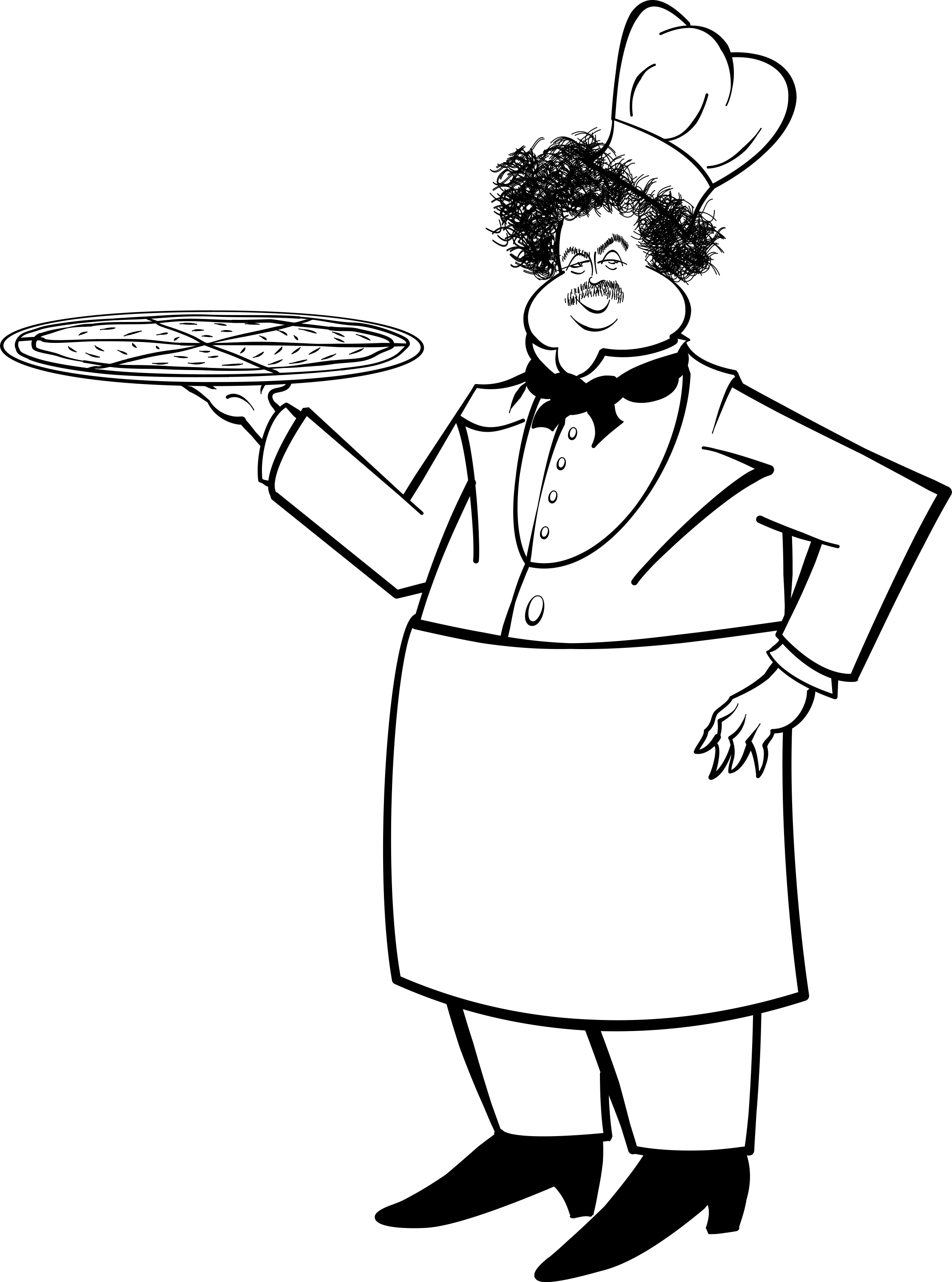
Naturally the question everyone asks is just what the hey does the famous French writer Alexandre Dumas - the author of The Three Musketeers, The Count of Monte Cristo, Robin Hood: The Prince of Thieves, and The Man in the Iron Mask - have to do with the quintessential Italian dish.
Well, for one thing Alex (as we'll call him) was quite the gourmet and he wrote a massive cookbook the Dictionary of Cuisine. The book was never published in his lifetime but is now available. Alex said he considered the Dictionary his greatest work, and if the stories about him are true, he was an expert chef and loved preparing food for his many guests.
But Alex was also quite a traveler. He visited countries and regions as varied as Switzerland, Spain, and the Caucasus. Naturally his enthusiasm for the delights of the table ensured he took particular note of the local cuisines. And one of those plats régionaux was pizza.
Scholars cite that the first reference to pizza was in 997 as reported in the multi-volume work Codice Diplomatico Gaetano edited by Salvatore Riciniello. In one place there is a statement that farmers must deliver twelve pizza's - duodecim pizze - to their bishop. But the document doesn't tell what these pizzas actually were. As we'll see the word has gone through variable meanings which may or may not be our pizza.
As far as the now iconic Neapolitan pizza, a popular informational reference work mentions that Alex was the first to describe this dish. And the same popular informational reference has an illustration of an early pizza baker. Although the pizzas are not shown in great detail they do kind of look like what are now called thick-crust individual pizzas.
On the other hand what Alex actually wrote in Sketches of Naples somewhat belies that the early pizzas had much resemblance to the modern comestible. However the pizzas were, Alex said, the most prized food of the poorest Neapolitans, the lazzaroni. As Alex wrote (here edited for brevity and clarity):
As to his [the lazzarone] food, this is more easy to describe; for, although the lazzarone belongs to the species omnivora, he, generally, eats but two things: the pizza and the cocomero or watermelon.
The pizza is a sort of bun; it is round, and made of the same dough as bread. At first sight, the pizza appears to be a simple dish, upon examination it proves to be compound. The pizza is prepared with bacon, with lard, with cheese, with tomatos, with fish.
But hold on! Here Alexandre says pizza is round and made from bread dough, with oil and lard, cheese, bacon, fish, and tomatoes. Sure sounds like modern pizza!
Weeehhhhheeeeellllll, not quite. A careful reading indicates that Alex is not describing the modern pizza. He refers to pizza as a "sort of a bun". Furthermore, if you turn to Alex's book in the original French, you'll find his word describing the pizza was talmouse ("La pizza est une espèce de talmouse"). And in French, a talmouse is a filling sealed within a pastry shell.
So it seems that what Alex described as the early Italians pizza was something different that our modern notion. And even as late as 1915 an Italian-English Dictionary published by a major university had the following definition:
Pizza f.; i. egg-shaped cheese. ii. a sort of a bun.
Since Alex was clearly not talking about egg-shaped cheese, it seems that the pizzas that he described are what we would call a calzone. In fact, you will find calzones described as "turnovers" filled with pizza toppings. You start off with a circular piece of dough which is covered with the inner goodies. So at one point in their making calzones look very much like a pizza. But then the crust is then folded over and sealed by crimping. With all the fillings sealed nice and tight, the final product could easily be placed in a basket which Alex mentioned was the way these early pizzas were carried.
A calzone is similar to a stromboli but a stromboli starts off with a rectangular piece of dough and is prepared by rolling the filling into a tube and then sealing the edges together with additional dough placed over the edges. To the uninitiated, calzones and strombolis can be easily confused.
But note if making a calzone - what seems to be Alexandre's pizza - and if the process is halted before the edges are sealed, the product will be a circular flatbread topped with vegetables, fruits, and meats.
In other words - a pizza!
At this point the traditionalists will stop and gleefully point out that Alex's writings in many ways contradicts other documented history. Alex, they point out, was not Italian and his experience with the daily life of indigenous Italians must have been limited. So let's read what was written about Italian cuisine - and pizza - by a bonafide Italian, Francesco De Bourcard in his Usi e costumi di Napoli e contorni descritti e dipinti:
Pizza isn't found in the Cruscan vocabulary because it's made with garlic and because it's a Neapolitan specialty, indeed, a specialty of the city of Naples.
Take a piece of dough, stretch it out with a rolling pin or beat it with the palms of your hands, add whatever comes to mind, drizzle it with oil or lard, bake it in the oven, eat it, and you'll know what pizza is. Focaccia and schiacciata are similar, but they're the embryo of the art.
The most ordinary pizzas, called "with garlic and oil," are topped with oil, and sprinkled with salt, oregano, and finely chopped garlic cloves. Others are covered with grated cheese and topped with lard, and then a few basil leaves are placed on top.
The former are often accompanied by small fish; on the second, thin slices of mozzarella. Sometimes sliced ham, tomato, clams, etc. are used. Sometimes, by folding the dough over itself, it forms what is called a calzone.
So we see that yes, a pizza is made by adding toppings to a round piece of flatbread and cooked. Or you can take the pizza before baking and fold it over and make a calzone. What you get depends on where you stop the preparation. Hence Alex's confusion. But it certainly seems that there were pizzas made in Naples that were flat breads with tomatoes, meat, olives, fish (anchovies?), and cheese.
So the question still remains: When did the pizza with all the goodies - vegetables, cheese, and meat - come into fruition? And above all else, where?
Alberto
(Click to zoom in and out)
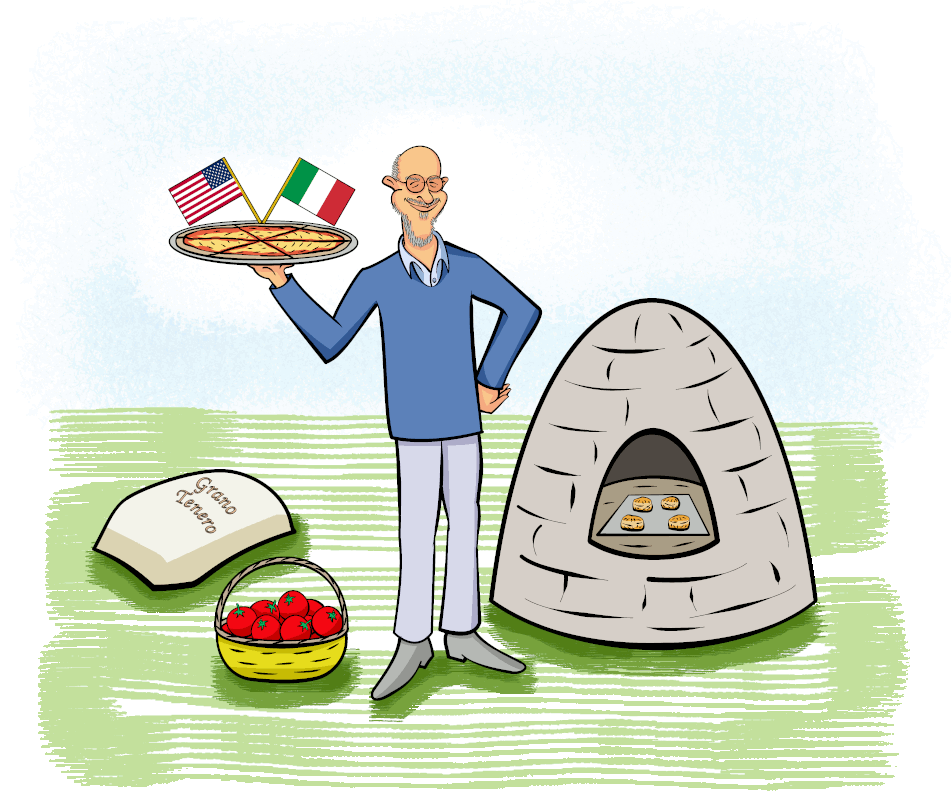
At this point the discussion drifts into an area of considerable controversy. The recent research of Dr. Alberto Grandi, Professor of Economic History at the University of Parma, has upended the story of Italian food as a tradition extending back millennia before being exported to the countries of the Western Hemisphere. Instead Professor Grandi has advanced arguments that much of Italian food believed to be indigenous was actually developed by Italian immigrants in the Americas and then re-imported to Italy in the early 20th Century. Naturally many citizens of Repubblica italiana disagree, particularly since in in 2025, the United Nations Educational, Scientific and Cultural Organization - called UNESCO for short (and pronounced you-NESS-koh) - declared Italian food was on the "Intangible Heritage" list.
Here a little clarification is in order. American food need not be limited to North American food and certainly not to food restricted to comestibles created in gli Stati Uniti d'America. And Professor Grandi stated that the Italian immigrants who came to America in the 19th Century did so because back home they were starving. But in America - North and South particularly in New York, Buenos Aires, and San Paulo - they found food was abundant and there were many new ingredients that were rare in Italy. This included an abundance of vegetables (particularly tomatoes) and meats, especially pork and above all beef.
But the one ingredient missing from the authentic native Italian delectories is tomato sauce. Although the name is found in English stretching back to the early 1600's and the Italian salsa di pomodoro shows up in the 1700's, the name - in English or Italian - really comes into wide use around around the second decade of the Twentieth Century.
Professor Grandi addresses the Tomato Sauce Scarcity directly stating that tomato sauce used on pizza was from New York, not Naples. Another scholar has agreed and even devoted a full length book to the study of tomato sauce in Italian food and concluded it was indeed from the Italian-American community.
Now a popular informational reference work - or the information algorithmically extracted - states emphatically that the earliest cookbook to provide a recipe for tomato sauce was from 1924 - a most amazing statement since a human being looking through archives of cookbooks readily finds a reference to tomato sauce in a cookbook from 1887 which states:
Take a quart can of tomatoes, put it over the fire in a stewpan, put in one slice of onion and two cloves, a little pepper and salt; boil about twenty minutes; then remove from the fire and strain it through a sieve. Now melt in another pan an ounce of butter, and as it melts, sprinkle in a tablespoonful of flour; stir it until it browns and froths a little. Mix the tomato pulp with it, and it is ready for the table.
Excellent for mutton, chops, roast beef, etc.
The point is that farms in the areas around New York, Philadelphia, and the nearby areas in New Jersey were bountiful in tomatoes and as all gardeners know, tomatoes are among the most readily raised of crops. So the Italian immigrants in the region - and there were lots - found a cornucopia of fat luscious tomatoes all the better for making tomato sauce. So they took their old recipes from Italy - such as the bland near-tasteless polenta - and altered them to fit what was available. Spaghetti - often simply served in Italy with garlic and grated cheese - was covered with tomato sauce and ground meat to produce the misnamed but delicious Spaghetti Bolognese. Recipes also emerged where the ground beef was fashioned into small spheres and served with pastas, one such dish becoming what Americans see as the quintessential and tasty Italian dish, yes, Spaghetti and Meatballs.
Then once the Italian Americans became settled and increasingly prosperous, they wrote back to their families and friends in Italy. Naturally they would send over their new recipes. Those who remained in Italy and whose fortunes had improved gave the new cooking a try and they liked what they ate. Some of the American immigrants or their descendants even returned to Italy and would bring their new cuisines with them.
But even if new dishes were created in Italy, the American influence remained. For instance, Professor Grandi has said that the beloved pasta alla carbonara was not the long-standing native Italian traditional dish prepared from pork jowls and pecorino cheese as is often believed. Instead it was invented in Italy, yes, but only AFTER World War II and using American GI provisions like bacon and powdered egg yolks.
At this point, these findings, particularly that regarding the ubiquity of tomato sauce in Italian cooking - leads to the inescapable but necessary and sufficient conclusion:
 Neapolitan
Pizza is really American!!!!!
In fact, ALL of the pizza that the world now consumed in quantity was first fashioned in America.
At this point the Tradizionali will snort in derision and point out that Italians DO SO have a native cuisine going back into antiquity. These included pasta dishes as well as a flatbread covered with toppings, the latter being known in Roman times. If that ain't pizza, ain't nothing is pizza!
Well, perhaps not. Not all flatbreads are created equally pizza. We know from murals that the "pizza" of Ancient Rome was simply fruits and vegetables spread out on thin bread and apparently sans frommage. Instead, pizza didn't become the famous gustatory delight covered with meats, vegetable, cheese AND tomato sauce - until it was invented in the New World.
Again i conservatori sneer at such naïveté and point out with considerable conviction that i revisionisti are ignoring THE FACTS. Even American reference sources point out that one form of pizza that is seeing increasing popularity in the New World is white pizza. This is, they say, exactly what was mentioned in the old writings - round flatbread covered with cheese with added embellishments but without - that's WITHOUT! SANS! SENZA! tomato sauce! Even American references point out that white pizza is AUTHENTIC ITALIAN CUISINE!!!!!.
Again the Americani and their amici laugh loudly. Why, they say, the so-called "white" pizza is just the Americanized pizza with the tomato sauce left off! Surely, anyone can see that ...
Certainly at this point the debate about what constitutes authentic Italian and its dividing line with Italian American food is unlikely be resolved to everyone's satisfaction. But whatever its origins, Italian food and drink remain among the tastiest of the world's victuals and is almost synonymous with good cheer and enjoyment.
So perhaps ending this essay with a little casual cuisinical comedy is in order:
How do Italian chefs edit their recipe books?
They cut and pasta.
Why do golfers never like pizza?
They never want to see a slice.
What would Benjamin Franklin have said if he was Italian?
A penne saved is a penne earned!
And finally there's:
Why did the Italian say when an American tried to serve him an authentic Italian meal with fettuccine alfredo, spaghetti and meatballs, chicken parmesan, garlic bread, pepperoni pizza, shrimp scampi, caesar salad, lobster Fra Diavolo, veal parmesan, stuffed shells, manicotti, chicken marsala, eggplant rollatini, and pasta primavera?
"Those aren't Italian! They're im-pastas!"
References
"Alexandre Dumas's Magnum Opus Was a Massive Cookbook", Rohini Chaki, Atlas Obscura, March 12, 2019.
"Is There No Such Thing as Italian Cuisine?", Thomas Fabbri, BBC, February 28, 2025.
"The Myth of Traditional Italian Cuisine Has Seduced the World. The Truth is Very Different", Alberto Grandi, The Guardian, December 15, 2025.
"The 100-Year-Old Loophole That Makes California Champagne Legal", Josh Malin, Vine Pair, June 29, 2015.
Sketches of Naples, Alexandre Dumas, E. Ferrett and Company, 1845.
Le Corricolo, Alexandre Dumas, Paris, 1843.
Usi e costumi di Napoli e contorni descritti e dipinti, Francesco De Bourcard, Stabilimento Tipografico Di Gaetano Nomle, 1858.
An Italian Dictionary, Alfred Hoare, Cambridge University Press, 1915.
"Il professor Grandi e la cucina italiana: 'Attenti a non confondere le radici con l'identità'", La Repubblica, March 23, 2023.
"Red Sauce: How Italian Food Became American", Wendy Holloway, Flavor of Italy, October 28, 2025.
Red Sauce: How Italian Food Became American, Ian MacAllan", Rowman and Littlefield, 2022.
"Tomato Sauce", Mrs. F. L. Gillette and Hugo Ziemann (Steward of the White House), The Whitehouse Cookbook - Cooking, Toilet and Household Recipes, Menus, Dinner-giving, Table Etiquette, Care of the Sick, Health Suggestions, Facts Worth Knowing, Etc., Etc. - The Whole Comprising A Comprehensive Cyclopedia of Information for the Home, 1887.
"What Is White Pizza?", Cuisine Seeker, May 30, 2022.
"14 Italian Foods in America That You Won’t Actually Find in Italy", Omega Ukama, New Interesting Facts, October 1, 2024.
"Tomato Sauce", Chronicling America, 1736-1963.
"Tomato Sauce", Ngram Viewer.
"Salsa di pomodoro", Ngram Viewer.