Permetteteci di presentarvi
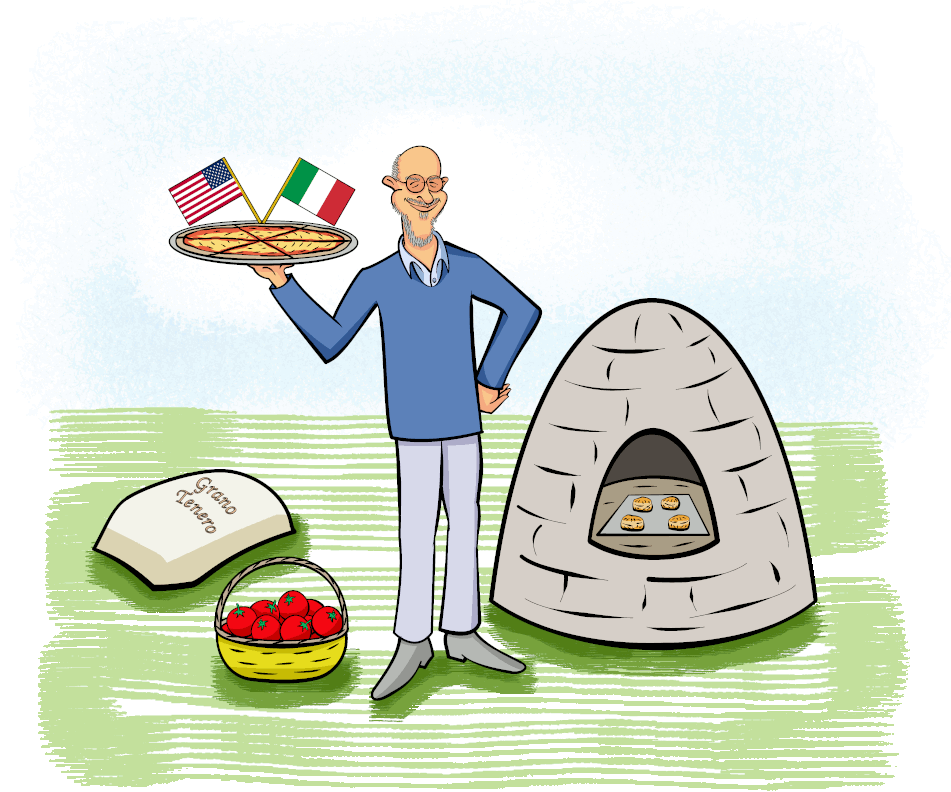
L'illustre Professor
Alberto Grandi
(Click on the image to zoom in and out.)
EVERYONE knows somebody who at a family dinner or a workplace lunch will in the midst of conversation and apropos of nothing say, "Hey! Did you know that [chop suey, vichyssoise, fajitas, or chicken teriyaki] aren't really [Chinese, French, Mexican, or Japanese]? They're really American!" Then he'll sit back and expect the others to express astonishment at his learning and wit.
But the favorite example of the It's-Not-Foreign-But-Really-American-Food has to be spaghetti and meatballs. The gourmands point out that it was really invented in the 19th Century by the Italian immigrants who came to America with their native cuisine. Using the new ingredients available in their new home they created what Americans think of as the most veritable of Italian food.
So the truth is they tell you:
 If you want
real Italian food you must go to Italy!!!!!
In fact, in 2025, the United Nations Educational, Scientific and Cultural Organization - called UNESCO for short (and pronounced you-NESS-koh) - declared Italian food was on the "Intangible Heritage" list. Naturally this proclamation produced much joy and jubilation among many residents of Repubblica Italiana.
It should be clarified that Italian food being on UNESCO's Italian Intangible Heritage list is not the same thing as being listed by a Protected Designation of Origin (or PDO). Instead, a PDO is a classification of the European Union that certain names of products must be restricted to those manufactured in a particular location.1 Even if a product that is manufactured elsewhere has the same composition then some other name has to be used. Among "foods" (note quotes) on the PDO list are Bayonne ham, Normandy camembert, Munster cheese, Roquefort, Feta, Parmesan, Glouster cheese, Stilton2, Napa Valley, and even Champagne.3
Footnote
Some of the products are actually banned in the United States, particularly if they use raw products which might contain bacteria or other critters. For instance, Casu Marzu is a cheese from Sardinia and is banned in the US and in many other countries since among its ingredients necessary for producing the soft smooth texture are live maggots.
Footnote
Ironically because of the specifications of the locations, cheese made in Stilton, England, cannot be called Stilton!
Footnote
Because of a unique loophole in the complex regulations and treaties designating the Protected Designation of Origin, California Champagne can still be called Champagne.
But ... but .... but.... There's plenty of places in America where you can order a nice slice of Neapolitan pizza. Shoot, you can even buy Neapolitan Pizza in Tulsa, Oklahoma, for crying out loud! What's the big deal?
Here the buongustai Italiani smile behind their hands. Well, you can say that Tulsan Pizza is Neopolitan if you want. But calling a tail a leg does not mean a dog has five legs. So:
if you want
REAL NEAPOLITAN PIZZA you still have to go to Italy!!!!!
Here is where the research of Alberto Grandi, food historian and professor of economic history at the University of Parma in Italy, steps in. In his many years of research Professor Grandi has come to the conclusion that:
The origin of
authentic Italian food is 19th Century America!!!!!
Eh? Ma cos'è?
Non ci posso credere!
Well, if you want some even more unexpected findings:
Much of the
authentic Italian cuisine was created after the mid-20th Century!!!!!
Here a little clarification is in order. American food needs not be limited to North American food and certainly not to food restricted to comestibles created in gli Stati Uniti d'America. And Professor Grandi stated that the Italian immigrants who came to America in the 19th Century did so because back home they were starving. But in America - North and South particularly in New York, Buenos Aires, and San Paulo - they found food was abundant and there were many new ingredients that were rare in Italy. These included an abundance of vegetables (particularly tomatoes) and meats, especially pork and above all else, beef.
So when the immigrants arrived in America, their recipes from Italy - such as the bland near-tasteless polenta - were altered to fit what was available. Spaghetti - often simply served in Italy with garlic and olive oil - was covered with tomato sauce and ground meat to produce the misnamed but delicious Spaghetti Bolognese. Recipes also emerged where the ground beef was fashioned into small spheres and served with pastas, one such dish becoming what Americans see as the quintessential and tasty Italian dish, yes, Spaghetti and Meatballs.
But perhaps the biggest controversy in Italian-Is-Really-American is the conclusion that:
Neapolitan
Pizza
is really

In fact, the new claim is that ALL of the pizza that the world now consumes in quantity was first fashioned in America.
At this point the Tradizionali will snort in derision and point out that Italians DO SO have a native cuisine going back into antiquity. These aren't just pasta dishes either. Flatbread covered with toppings was known in Roman times.
AND if that ain't pizza, ain't nothing is pizza!
Again the American Champions step in. Not all flatbreads are created equally pizza. They point out that murals from Rome show that the "pizza" was simply fruits and vegetables spread out on thin bread. Instead, it's obvious that the pizza didn't become the famous gustatory delight covered with tomato sauce, meats, and cheese until it was invented in the New World.
But hold on there, pellegrini! Take a look at the writings of no less a personage than the French writer Alexandre Dumas. In 1843, he left us his impressions of a visit to Naples. There he mentions that one of the foods most prized by the poorest Neapolitans, the lazzaroni, was pizza. It wasn't just fruit on flatbread. The ingredients included cheese, olive oil, and meats.
Or as Alexandre wrote it:
As to his [the lazzarone's] food, this is more easy to describe; for, although the lazzarone belongs to the species omnivora, he, generally, eats but two things: the pizza and the cocomero or watermelon.
So clearly there are early references to what the world calls pizza!
Weeehhhhheeeeellllll, not quite. A careful reading reveals that Alexandre is not describing the modern pizza. He refers to pizza as a "bun" with bacon, fish, tomatoes, and olive oil. But he also says that pizza can be carried in a basket. Certainly putting the pizzas that we know in a basket would be a recipe - no joke intended - for one messy basket.
Furthermore, if you turn to Alexandre's book in the original French, you'll find the word describing the pizza was in fact talmouse ("La pizza est une espèce de talmouse comme on en fait à Saint-Denis"). And in French, a talmouse is a pastry shell with a filling.
So when Alex says "pizza" it seems he was referring to a calzone. Pizza and calzones are related, yes. In fact if you halt the process of making a calzone before folding and sealing the edges, you will have a circular flatbread topped with vegetables, fruits, and meats.
In other words - a pizza!
Those who hold that Pizza-Is-Italian will mention that Alex was not himself Italian. To resolve the question the true scholar should turn to the writings of the early and bonafide Italian from the mid-19th Century, Francesco De Bourcard. Francesco, we must point out was not just an Italian but a Neopolitan and in his book Usi e costumi di Napoli e contorni descritti e dipinti he specifically talks about the pizza.
Pizza isn't found in the Cruscan vocabulary because it's made with garlic and because it's a Neapolitan specialty, indeed, a specialty of the city of Naples.
Take a piece of dough, stretch it out with a rolling pin or beat it with the palms of your hands, add whatever comes to mind, drizzle it with oil or lard, bake it in the oven, eat it, and you'll know what pizza is.
So here we have a bonafide Neapolitan writing well before the 20th Century describing what we recognize as pizza and it IS a Neopolitan speciality.
So for REAL NEOPOLITAN PIZZA you go to Naples, non è così?
Once more the Americani smile that things are not quite so simple.
From these descriptions the one ingredient missing from the early native Neopolitan pizza is tomato sauce. Although the name is found in English stretching back to the early 1600's, the Italian salsa di pomodoro shows up in the 1700's. But the name - in English or Italian - really comes into widespread use only in the 1900's.
So the question remains. When did the pizza with all the goodies - vegetables, cheese, meat, AND tomato sauce - come into fruition? And above all else, where?
Professor Grandi addresses The Great Tomato Sauce Question stating that tomato sauce used on pizza originated from New York, not Naples. Another scholar has agreed and even devoted a full-length book to the study of tomato sauce in Italian food. He concluded salsa di pomodoro was indeed from the Italian-American community.
Now a popular informational reference work - or the information algorithmically extracted - states emphatically that the earliest cookbook to provide a recipe for tomato sauce was from 1924. This is a most amazing statement particularly since a human being looking through archives of cookbooks readily finds a reference to tomato sauce dating from 1887 and which states:
Take a quart can of tomatoes, put it over the fire in a stew-pan, put in one slice of onion and two cloves, a little pepper and salt; boil about twenty minutes; then remove from the fire and strain it through a sieve. Now melt in another pan an ounce of butter, and as it melts, sprinkle in a tablespoonful of flour; stir it until it browns and froths a little. Mix the tomato pulp with it, and it is ready for the table.
Excellent for mutton, chops, roast beef, etc.
The point is that farms in the areas around New York, Philadelphia, and the nearby areas in New Jersey (The Garden State) were bountiful in tomatoes and as all gardeners know, tomatoes are among the most readily raised of crops. So the Italian immigrants in the region - and there were lots - found a cornucopia of fat luscious tomatoes all the better for making tomato sauce.
But even if new dishes were created in Italy, the American influence remained. For instance, Professor Grandi has said that the beloved pasta alla carbonara was not the long-standing native Italian traditional dish prepared from pork jowls and pecorino cheese as is often believed. Instead it was invented in Italy, yes, but only AFTER WORLD WAR II and using American GI provisions like bacon and powdered egg yolks.
The debate of the origins of Italian food and its degree of American influence is an on-going topic and will not likely soon be resolved to everyone's satisfaction. But whatever the origins, Italian food and drink remain among the tastiest of the world's victuals and are almost synonymous with good cheer and enjoyment. Italian food has spread far and wide even to the most remote regions of the globe.
But exactly how remote?
Well, suppose you are 3565 miles from Lima, Peru, 3314 miles from Aukland, New Zealand, 3363 miles from Honolulu, Hawaii, and 3638 miles from Guadalajara, Mexico. Where could you go to get a nice tasty pizza?
Well, in 1789, an able seaman who had been promoted to acting lieutenant on a ship that had been named the HMS Berthia felt discombobulated. They were returning from the South Pacific to England where they had picked up a shipment of exotic breadfruit.
But on the trip the young lieutenant's boss - named William - had accused him of filching one of his coconuts. In doing so William called him a "rascal" and even used profanity, adding he was a "damn'd hound".

So on April 4 the young lieutenant - whose name was Fletcher - and a group of his buddies woke William up and set him and about 18 others adrift in a small boat.4 Then Fletcher and the rest sailed away on the ship that had been renamed before the voyage as His Majesty's Armed Vessel the Bounty.
Footnote
In one of the most amazing feats of navigation, William - whose last name was Bligh - after a voyage of over 4000 miles managed to sail the boat to Timor, an island with both Dutch and Portuguese colonies in Indonesia. William managed to get back to England and after a promotion to Captain - on the Bounty he was a lieutenant - he sailed back to Tahiti and got the breadfruits. He was not, the movies notwithstanding, involved in trying to capture the mutineers.
Eventually Fletcher and some others took the Bounty to a small island that was, yes, 3565 miles from Lima, Peru, 3314 miles from Aukland, New Zealand, 3363 miles from Honolulu, Hawaii, and 3638 miles from Guadalajara, Mexico. Their descendants live there to this day with many modern conveniences.
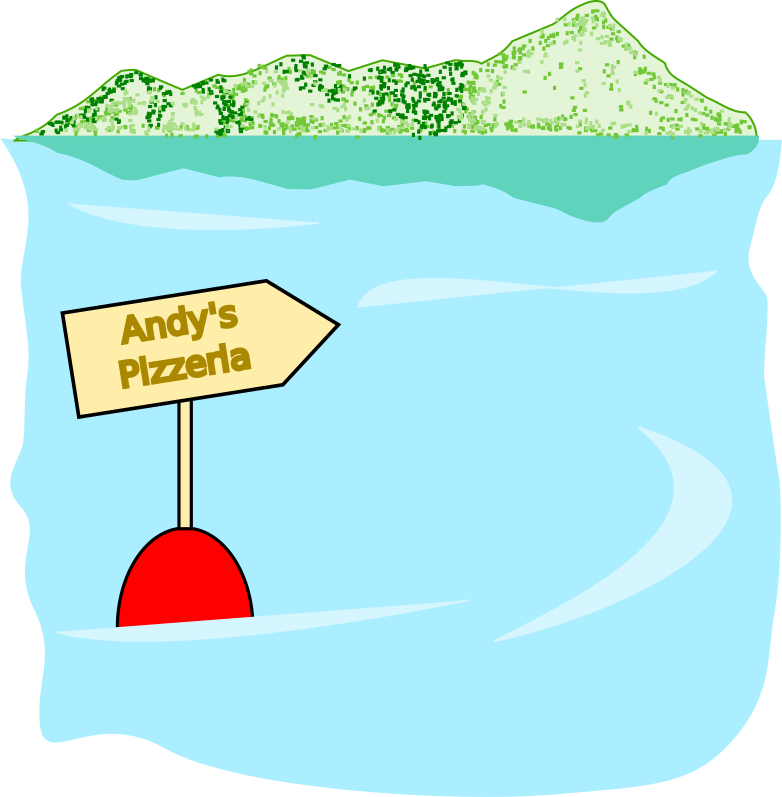
So you can enjoy a nice slice of the Italian4 mainstay - at Andy's Pizzeria on Pitcairn Island!
References
"Is There No Such Thing as Italian Cuisine?", Thomas Fabbri, BBC, February 28, 2025.
"The Myth of Traditional Italian Cuisine Has Seduced the World. The Truth is Very Different", Alberto Grandi, The Guardian, December 15, 2025.
"Italian Food vs. Italian-American Food: What's the Real Difference?", Magnifico Food, Alessio Gambino, October 29, 2024.
"8 Pasta Dishes From Italy That Never Needed Meat or Cheese to Be Authentic", Dining and Cooking, November 19, 2025.
"Tomato Sauce", White House Cook Book: Collection of Choice Recipes, Mrs. F. L. Gillette, R. S. Peale and Company, 1887, p. 140.
"The 100-Year-Old Loophole That Makes California Champagne Legal", Josh Malin, Vine Pair, June 29, 2015.
Sketches of Naples, Alexandre Dumas, E. Ferrett and Company, 1845.
Le Corricolo, Alexandre Dumas, Paris, 1843.
An Italian Dictionary, Alfred Hoare, Cambridge University Press, 1915.